
Category: development

Randy Yu sounds alarm on Mui Wo population growth
District Councillor Randy Yu has called on government, police and transport providers to explain how they will cope with Mui Wo’s coming population boom.
The opening of two Housing Department estates in Mui Wo next August will add 700 new homes and increase the population by between 1,700 to 2,000 – a huge spike from the current level of around 5,400.
“The public is greatly concerned about the lack of community facilities,” Yu said in a question tabled to the Islands District Council.
Local residents are worried about the carrying capacity of the ferry and bus services, inadequate parking for cars and bikes, the level of medical services and the lack of police.
Yu, who represents South Lantau, said his office has even received calls from those who have purchased homes in the new estates expressing concern about the expensive ferry fares.
He called on the Transport Department, the Hospital Authority, police and the ferry and bus companies to attend next week’s District Council meeting to explain how they will address these issues.

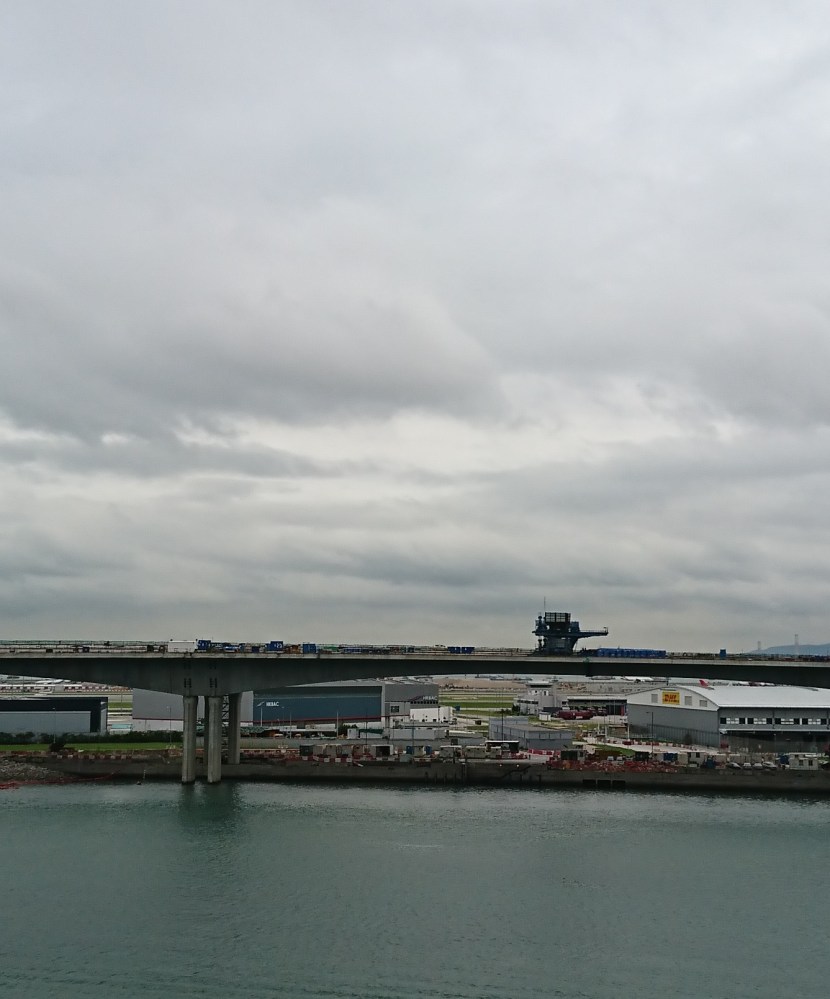
LaDA wants restrictions eased so bridge visitors can reach Lantau tourist spots
A local business lobby has called on the government to ease restrictions on HK-Macau bridge arrivals to make it easier for them to visit Lantau tourist spots.
The 30km bridge-tunnel across the Pearl River mouth, under construction since 2010, is officially due to open by the end of this year, two years after the original deadline.
Lantau Development Alliance (LaDA) chairman Spenser Au says his group had called on the government to allow tourists coaches to take visitors to Lantau Island attractions, but so far officials had resisted.
He says buses should be allowed into restricted areas to pick up passengers arriving on the 130-ha artificial island next to the airport. If not “there will be a large number of passengers stranded on the island in the future,” HK01 reports.
LaDa, which is backed by major developers and Lantau tourism operators, also urges the construction of a pedestrian link between the bridge arrival zone and the new business district north of the airport. It seeks the extension both the MTR and road connections to Tung Chung and a wider use of ferry transport to the airport and around Lantau as well.
Additionally, Au said the arrival of the HK-Macau bridge can make North Lantau a medical tourism destination. He called for the government to establish a pilot medical centre in the bridge landing area.
Under current plans the HZM Bridge landing zone is intended to support 500,000 square metres of space of retail, restaurants and entertainment.
TPB still weighing Pui O caravan park after more than 250 responses
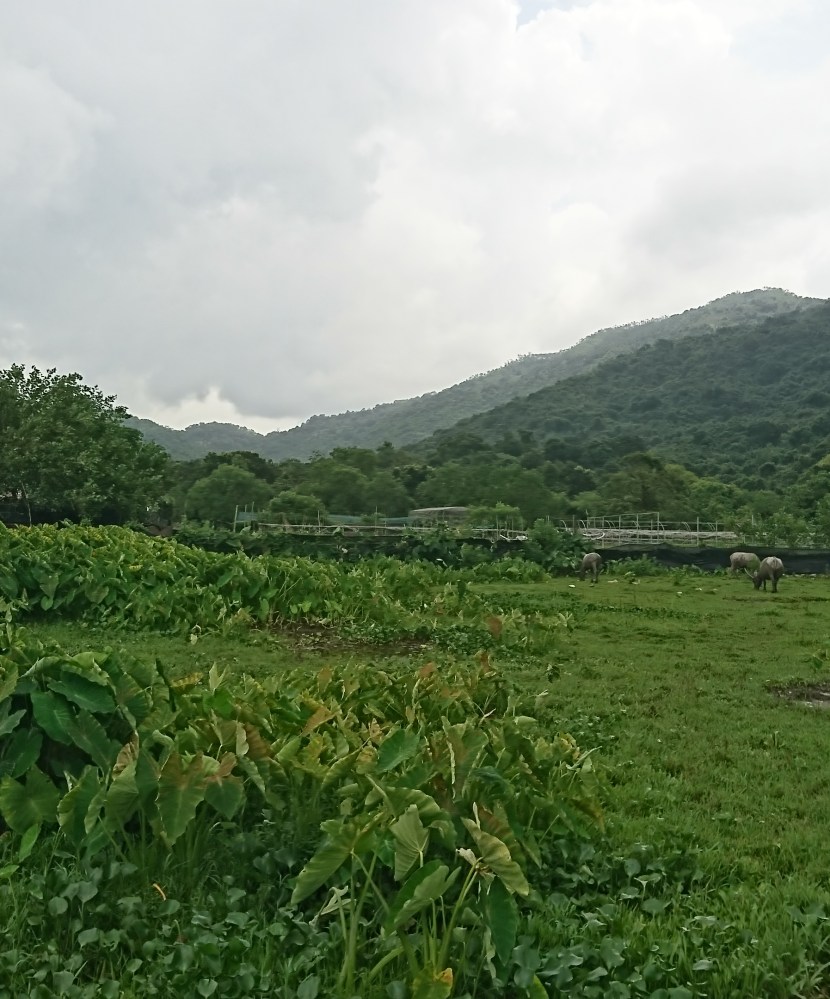
A plan to convert part of Pui O wetland into a caravan park is still under consideration by the Town Planning Board (TPB), three months after the original deadline.
TPB has given the owner, the JK Group, three extensions as it has responded to objections to its plans to build a caravan park and hobby farm across more than 1ha of wetland between Pui O and Ham Tin.
The TBP has received 252 comments on the plan since it was filed on May 16.
The site of the holiday camp covers wetland that provides critical habitat for the Ham Tin buffalo herd, flying in the face of the government’s intention to protect it.
The Sustainable Lantau Blueprint, unveiled in June, includes preservation of the Pui O wetland as part of its conservation plan.
After the original deadline of June 23 the deadline for public comment and submissions from the applicant was extended to July 28, after which the JK Group updated its traffic assessment and sewage facility proposal.
The deadline was then put back to August 18, when the company submitted new plans for tree preservation and landscaping and “further justifications on excavation of land for sewage facilities.”
The TPB received 136 comments before the initial deadline, 86 following the first extension and 30 after the second extension.
The current deadline for comments is September 29. The TPB has set a tentative date for discussion on October 27.
The JK Group owns a number of Pui O businesses , including Garden Plus, Garden Cafe, JK Properties and JK Club.
Calls to investigate ‘suspicious’ Mui Wo rural land deals
A Mui Wo village leader was directly involved in six village house transactions and connected to another three in the space of two years, prompting calls for the transactions to be investigated.
Civic Party leader and barrister Tanya Chan said while there was no clear evidence that small house rights were being sold, the land sales were “suspicious” and should be scrutinised.
Eddie Tse from the Save Lantau Alliance (SLA) said the transactions by Luk Tei Tong village representative Lee Kwok Keung and his wife were “intriguing,” especially when they involved residents from other villages. He called for the Lands Department and the Town Planning Board (TPB) to probe the deals.
According to the Ming Pao newspaper and the SLA, Lee and his wife sold land that was used to build six indigenous houses, while another three are applying for approval to build.
One plot of land, lot 288, was broken up and sold to six different buyers, including five from other villages.
Land sale contracts show Lee bought the lot for just under HK$2.78 million in 2011, and then selling it as six separate plots over 2012-2013 for HK$2.24 million – HK$540,000 less than he had paid. Every transaction was authorised by the same lawyer, Lee Kwok Yung.
Subsequently, a number of applications were made to build ding houses on those sites, which were approved in 2015 and 2016.

Lot 288
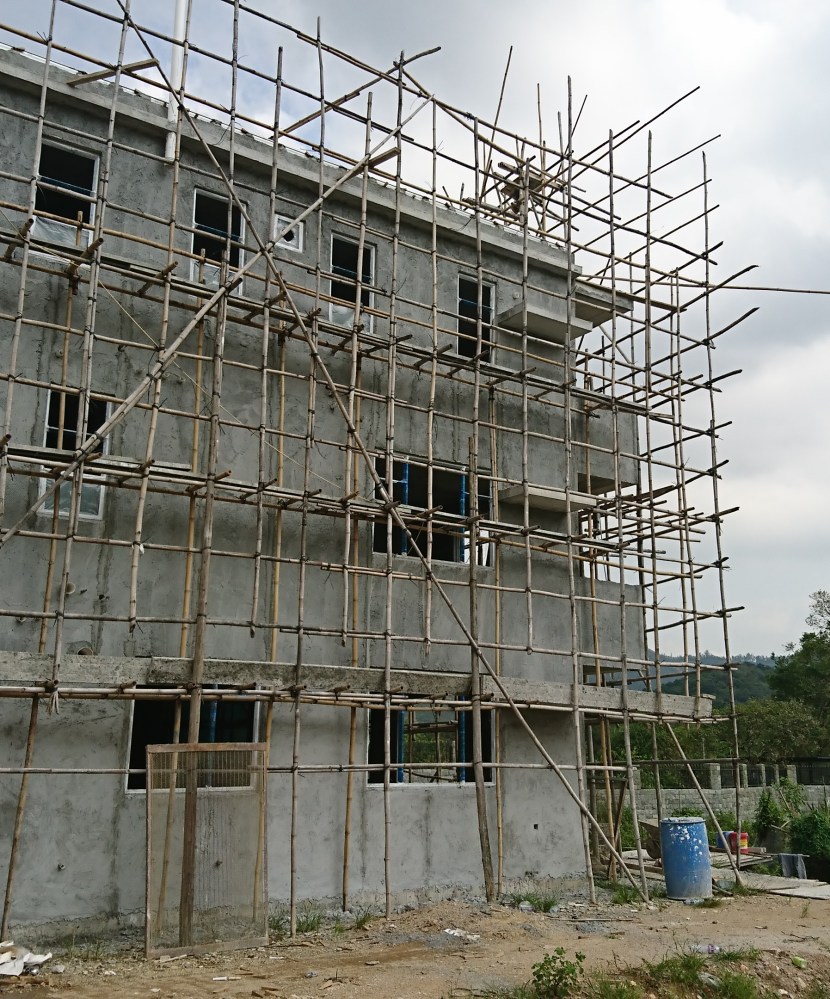
The six small houses, many with the same external appearance, have now been nearly completed.
Five of the buyers have addresses outside Mui Wo, including one in Australia, land sale documents show. Ming Pao reporters could not locate any of the buyers.
Lee’s wife, Fanny Mok Suk Fun, was involved in buying and selling another plot of land on the edge of Luk Tei Tong, lot 308. She had acquired it for HK$700,000 in 1999, split it into three pieces, and sold them off in 2004.
Then on the same day in 2008 Mok and a Ms Au-yeung Yuet-lan repurchased two of the lots at exactly the same price (HK$198,000). In 2014 the two lots were sold separately for the same price (HK$208,000) to two people now applying for ding approval. Both transactions were also executed by Lee Kwok Yung.
The third piece of land is also subject to a TPB application for building approval.
Speaking to a Ming Pao reporter by phone, Lee confirmed he had sold the land to residents of other villages and as village representative had dealt with the six small house applications.
However, when asked about his wife’s role the call dropped out. Reporters were unable to re-establish contact, and text messages were not returned.
The number of cross-village ding transactions in Lantau has soared since then-CE CY Leung announced ambitious Lantau development plans in his 2014 policy address.
In the two years prior, just three applications had been filed. But after the development plans were unveiled, the number of applications spiked to six in 2014, 14 in 2015 and six in 2016.
Under the Basic Law, indigenous male villagers are given the right to build a house on rural village land, but the system is open to abuse and, outside the privileged community of indigenous villagers, dissatisfaction is high.
Two years ago Sha Tin villagers were jailed for selling off ‘ding’ rights to a developer, and a 2015 Civic Exchange survey found that nearly two-thirds want to see the policy change.
However, successive chief executives, who hold power with support of rural bodies, have shown no interest in reform.

A masterclass in waffle: govt officials meet Lantau community
In Hong Kong, public consultations are like elections; they happen but they mean little.
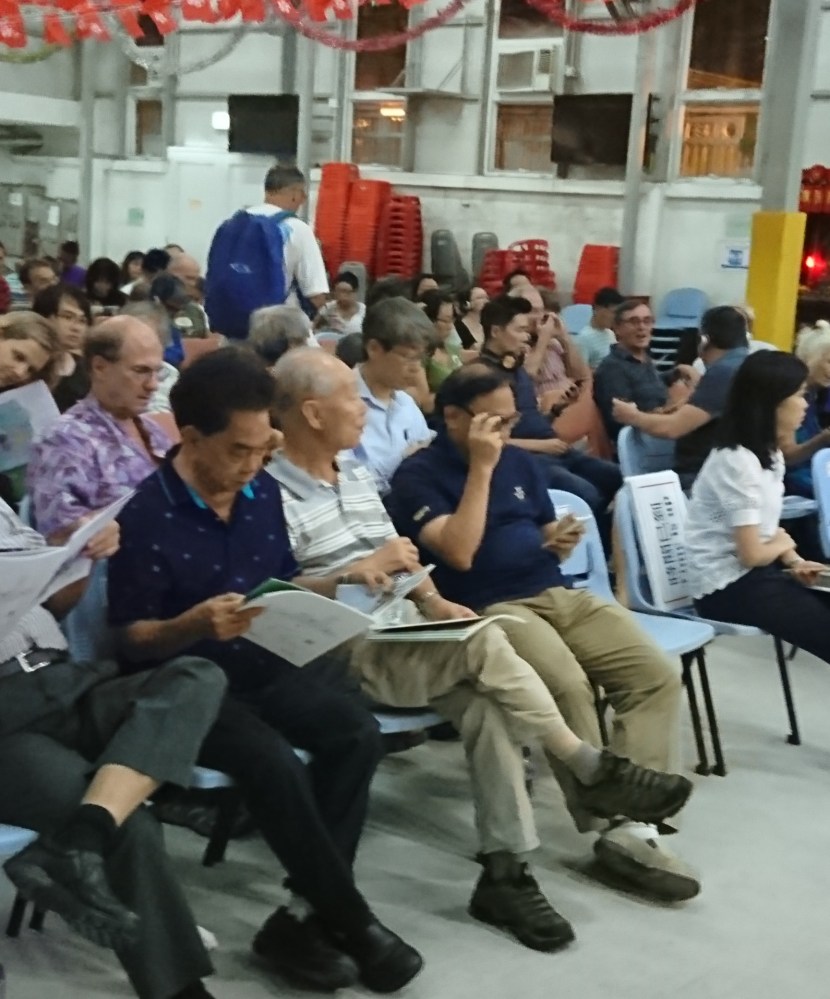
Last night’s meeting between officials from the CEDD and the Planning Dept and the Lantau community was a prime exercise in box-ticking.
After the forum Mui Wo resident Tom Yam, an outspoken critic of the development plans, posted an open letter to Robin Lee, the CEDD director for Lantau, pointing out the brief and tokenistic nature of the event.
If there were a highlight, it was probably from Robin Lee himself, who gave us a masterclass in dissimulation. If he were in Legco, he could singlehandedly sustain a filibuster.
Despite, or because of this, he occasionally managed get on multiple sides of the same issue.
On the vexed topic of cattle – something he acknowledged he knew nothing about – Lee suggested people should learn to live with cattle and buffalo while at the same time the animals should be shipped off elsewhere.
He railed against the idea that the Sustainable Lantau Office was loaded in favour of engineers over conservation experts (as reported yesterday, the top three layers of management are all engineers and planners), or that engineers lacked environmental knowledge.
Lee said all engineers had to work with the environment, and he personally had been working on environmental issues since he graduated. Perhaps this is what he means:
The meeting had time for just 15 questions in 45 minutes. A slight majority was sympathetic to development plans, and the rest were critical in various ways, including Tai O’s Lou Cheuk-wing, who called for more development at that end of the island.
If one thing emerged it is that Mui Wo will be at the centre of the action, both in development plans and disputes over land use.
The Sustainable Lantau Blueprint urges the preservation of Mui Wo’s “rural township character,” but officials made it clear last night it will be a major population growth centre, starting with the new HOS apartments next year. The East Lantau Metropolis (ELM) envisages a freeway and an MTR running through it.
Meanwhile, since ELM was announced in 2014, there’s been a sharp rise in land deals between Mui Wo villagers. Watch this space.

Sustainable Lantau in name only, govt plans confirm
Plans for the new Sustainable Lantau Office (SLO) dispel any doubts about the role of conservation in Lantau development schemes.
It has no role at all.
The SLO, supposedly a multidisciplinary agency that will ‘balance’ development and conservation, will in fact be a unit within the Civil Engineering and Development Department (CEDD) dominated by engineers and planners.
The top three layers of management will all be engineers, planners or construction professionals. Of the top 16 posts, only one – four ranks down – will be a conservation specialist.
The Development Bureau set out the SLO’s priorities and staffing needs in a submission last month to the Legco establishment subcommittee, which deals with civil service appointments.
It sought permission to create four new senior positions at the top – three engineers and a planner – and to bring in 22 Civil Engineering and Development Department (CEDD) staff (the subcommittee endorsed the proposal except for one of the CEDD staff posts).
The paper repeats the environmental messages of earlier studies, including the main report, the Sustainable Lantau Blueprint:
..the planning vision is to balance and enhance development and conservation with a view to developing Lantau into a smart, low-carbon community for living, work, business, leisure and study.
When it gets into the specifics of its priorities, it lists out a more than a dozen development projects (see below), including the Tung Chung expansion, the artificial island for the HK-Macau bridge border crossing and the controversial HK$248 million feasibility study into the East Lantau Metropolis.
By contrast, it doesn’t have a single conservation project on its agenda. Instead, refers to initiatives “that are being explored.”
The SLO was originally called the Lantau Development Office, but changed its name following criticism from Legco members that it gave too little weight to the environment.
In reality it is a unit dedicated to outlying islands development with a token nod to conservation. The original title was at least accurate.
The SLO’s priorities, as set out by the Development Bureau:
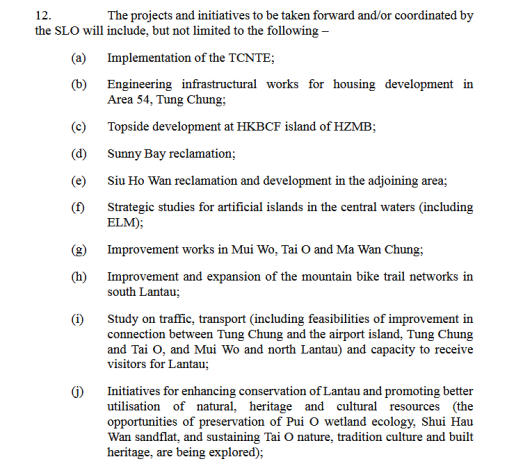
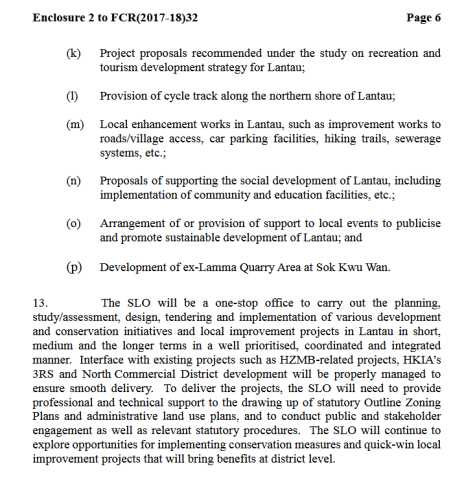
Photo (top): Kau Yi Chau island, core of the ELM
CEDD wants your opinion even if Randy Yu doesn’t
Good news, non-Chinese residents of Lantau.
The government thinks you’re worth talking to, even if our district councillor doesn’t.
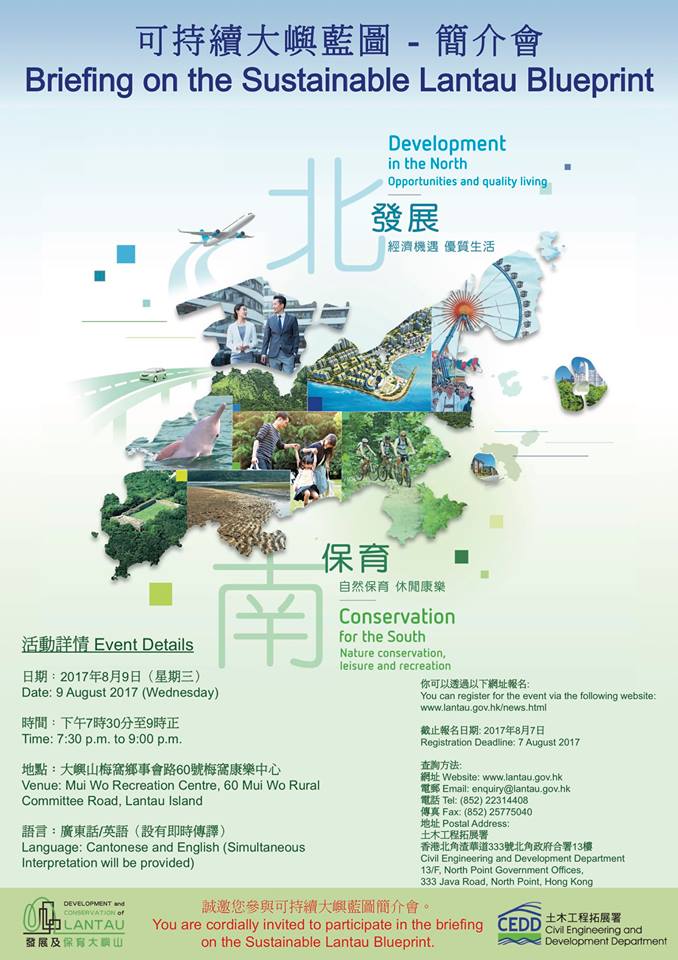
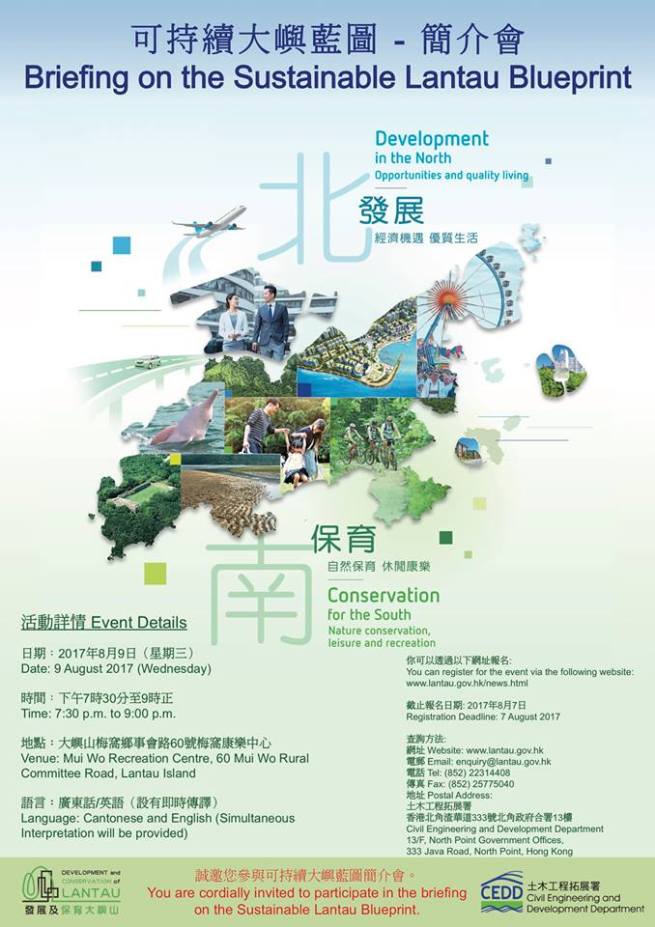
The Civil Engineering and Development Dept (CEDD) has finally issued an English-language invitation to a public forum in Mui Wo on the Sustainable Lantau Blueprint.
By contrast, Randy Yu, the Islands District Councillor announced the event on his Facebook page two weeks ago like this:
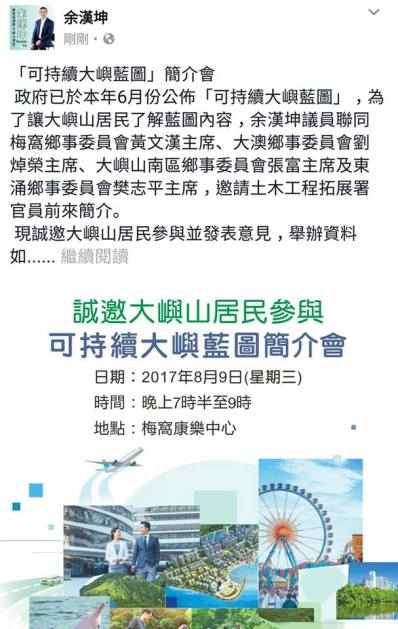
Early this year he incensed some residents when he held a public consultation (on East Lantau Metropolis) that only a few seemed to know about.
This time no one can complain about not being invited. Too bad a third of the community can’t read the invitation.
In fact, Yu’s entire Facebook page is in Chinese. If he has any interest in communicating with non-Chinese members of the community, there’s no sign of it – an unusual attitude for somebody whose job depends on winning people’s votes. Randy Yu and his staff also seem to be unaware that English is an official language.
Despite the rhetoric around sustainability, the August 9 event will be dominated by pro-development interests. As well as Yu and the CEDD, all four Lantau rural committees will be represented. A minor furore has broken out over the latest sign of environmental tokenism, the appointment of a recently-retired planning bureaucrat as Lantau’s ‘conservation coordinator.’
Those who wish to attend will need to register by August 7. Send your emails to enquiry@lantau.gov.hk.
Here is the CEDD Chinese/English flyer, issued Friday:
Mui Wo’s coming population boom
Around this time next year Mui Wo’s population will undergo a sharp expansion with the completion of two new public housing projects.
The new estates, Ngan Ho Court and Ngan Wai Court, will provide 700 new apartments, enough to support approximately 2000 new residents. That means the current Mui Wo population of around 5,500 will increase by 35% or more.
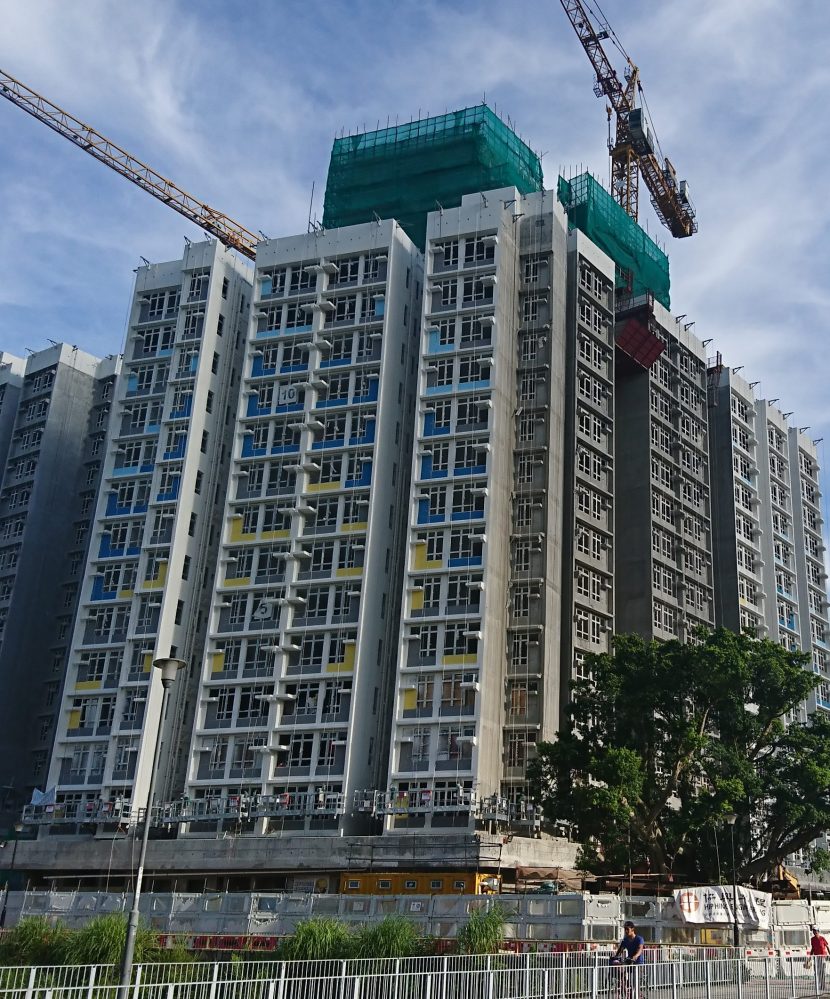
The bigger of the two will be Ngan Ho Court, at the end of Ngan Kwong Wan Road. It comprises two blocks, one 18 and the other 16 storeys, altogether containing 529 apartments.
Ngan Wai Court, which faces the rear of the Mui Wo clinic on Ngan Kwong Wan Rd, is a single 16-storey block with 170 homes.
Q: Why Mui Wo?
The Hong Kong government has built subsidised public housing since the 1950s. Today, 46% of the population lives either in public rental or subsidised sale flats. These new apartments are built under the Home Ownership Scheme (HOS), one of several different programmes aimed at increasing the supply of affordable housing. Dozens of HOS estates provide housing for hundreds of thousands of people, including in Yu Tung, Tung Chung, and Lung Hin, Tai O.
Q: Why this part of Mui Wo?
Most land in Mui Wo belongs to indigenous villagers whose privileges are enshrined in the Basic Law. Ngan Ho is officially zoned in Mui Wo Fringe, while Ngan Wai falls into no zoning plan at all. No indigenous villager in Mui Wo is giving up any of his entitlements to alleviate the housing crisis.
Q: When will people start moving in?
According to the builders, both housing estates will be completed by August 31 2018. New residents will start moving in after the date.
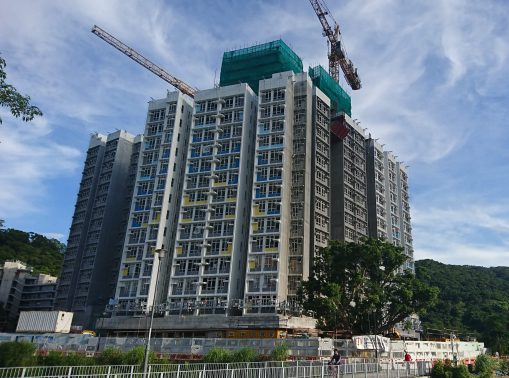
Ngan Ho Court
Q: Are these units to be rented or for sale?
For sale. The sale is carried out by ballot and according to certain eligibility criteria.
Q: These aren’t the first public housing projects in Mui Wo, right?
They’re not even the first on Ngan Kwong Wan Rd. The Ngan Wan Estate, built in 1988, has 400 rental apartments in four tower blocks, with a population capped at 1,300.
Q: That’s a lot of extra people moving in. Can our transport services cope?
We don’t know. The New Lantao Bus Company is considering running double-decker buses to Mui Wo. It says details of its preparations will be contained in a five-year plan for the Transport Department.
New World First Ferry said, in response to a query from Bob Bunker of Living Islands Movement:
“We are collecting the data from related governmental departments in order for us to review and devise the overall sailing arrangements in the following years. Please be assured that we will closely monitor the change of passenger demand and provide appropriate sailing arrangements.”
We will post the Transport Department’s reply when it arrives.
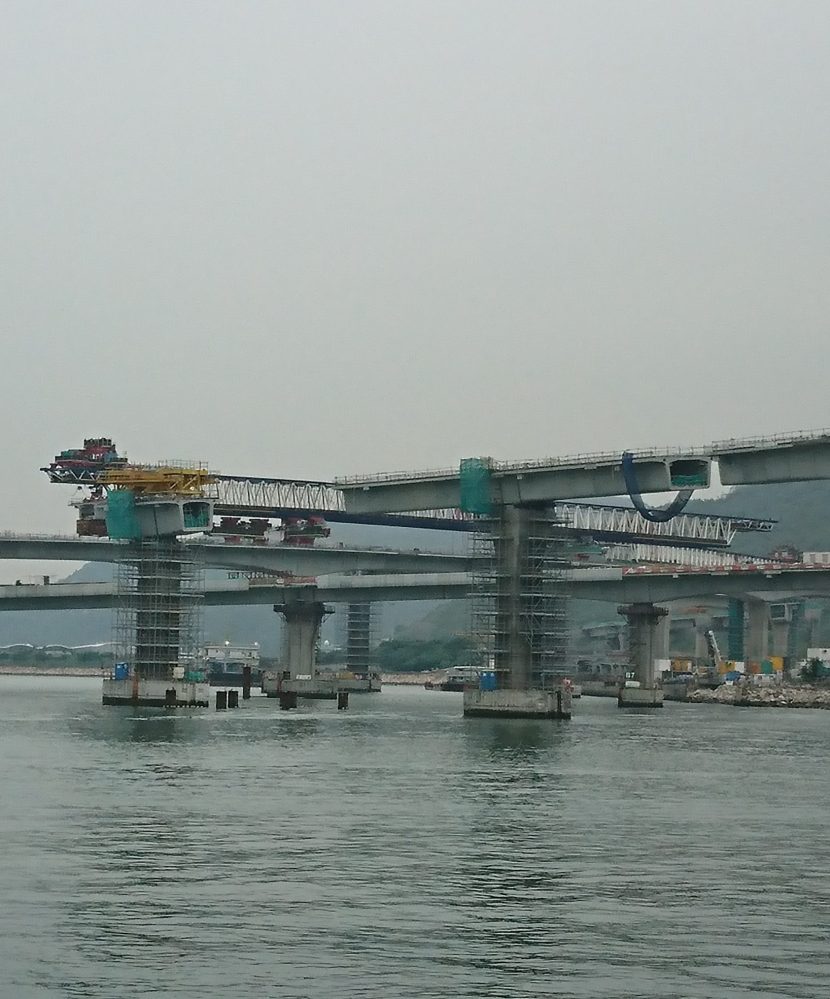
HK-Macau bridge foundations shift again
The foundations of a key part of the Hong Kong-Zhuhai-Macao Bridge have shifted again, the Highways Dept has revealed.
As many as 22 steel cylinders installed to stabilise reclaimed land for the bridge landing zone have shifted more than three metres, according to the Oriental Daily.
The Highways Dept and the contracting company have consolidated the cylinders – accounting for more than a quarter of the total – but have been unable to fix the source of the movement.
It is the latest in a series of engineering issues at the project, including shifting foundations, the collapse of a seawall and the falsification of tests on the concrete used in the bridge. Accidents have killed six workers and injured dozens, putting the project back by a year, experts have said.
The continual shifting of the foundations of the reclamation have prompted concerns that the project will be further delayed.
The 55-km bridge, originally intended to open last year, is currently scheduled to open by the end of 2017.
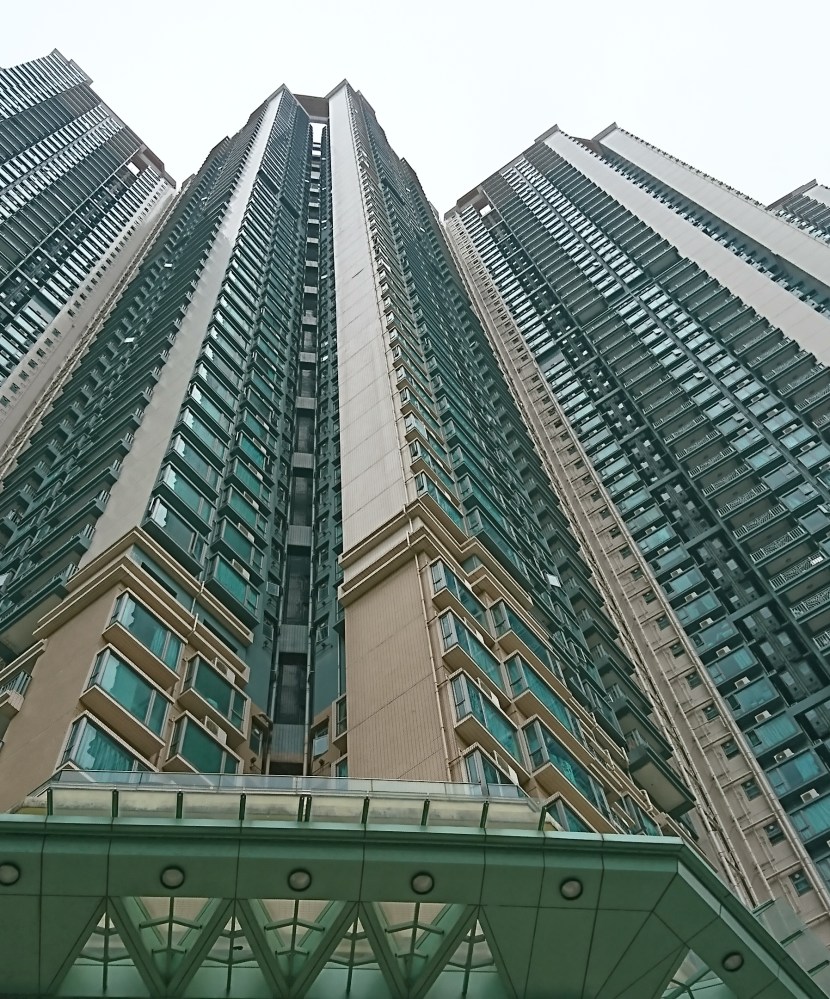
Tung Chung east reclamation to begin by year-end
Work on the Tung Chung East housing development will start by year-end and take six years to complete, according to a government tender document.
The Civil Engineering and Development Dept yesterday issued a tender for the reclamation of 130 hectares from Tung Chung Bay and the construction of 4.9km in seawalls and infrastructure.
It is the biggest part of what is officially known as the Tung Chung New Town Extension, which the government says is one of its most important land supply projects.
Under the project, the CEDD will build 49,400 new apartments and 877,000 sq metres of commercial space in developments in east and west Tung Chung in the next seven years.

Tung Chung east extension. Source: CEDD
The new apartments will house approximately 144,000 people, CEDD says. Combined with other developments underway, they expect Tung Chung’s population will increase from approximately 80,000 today to 268,000.
The first residents are expected to move in in 2023.
The issue of the tender follows Legco’s approval of HK$20.5 billion for the first funding tranche last month.
A new MTR station is planned for Tung Chung East, but is not likely to be completed until 2026.
 Lantau Confidential