Election time. Welcome to District Council world

Hong Kong’s 18 District Councils are not exactly a model of democratic accountability. They are a branch of the Home Affairs Bureau with no power to pass laws or raise revenue, and the coming poll is the first in which all members will be directly elected. But when it comes to community politics they are the only game in town.

Screenshot 2015-11-11 20.55.53 - Copy

Historically, they grew out of the neighbourhood support groups known as kaifong associations (街坊會) that the British formed back in 1949 (this wiki traces their tortuous history). Continue reading

The boondoggle infinite loop

For once it was not just Lantau people fretting about our transport problems. This past weekend we had not one but two accidents which threw the spotlight on Lantau and our fragile connections to the world.  Plus one excellent irony – of that more later.

The Sunday evening accident, where a returning Macau hydrofoil struck an object off the Sokos, was lucky not to involve any life-threatening injuries. Reportedly the object was a marine fender tyre. For anyone who has strolled the garbage-strewn Fan Lau beach nearby  that’s no surprise.

IMG_1715 - Copy

As a sailing master told the SCMP, such accidents are probably unavoidable in Hong Kong’s less than pristine waters. It won’t get any better off Lantau’s coast when the Environment Dept starts shipping 12,000 tonnes of household waste in and out of Shek Kwu Chau daily, but hey, let’s not see that as a negative. Continue reading

Report on HKT briefing

Yesterday (October 14th) the Islands Broadband Concern Group attended an informal background briefing from HKT’s Netvigator engineering and marketing teams on the islands broadband services.

During the briefing there was a sense that we are pushing at a slightly open door, and that within HKT there is an awareness of a need to deliver the kind of service customers on the islands today expect.

But bear in mind that their internal process as well as any future network upgrade will take time.

The IBCG’s own efforts to get improvements to remote areas broadband will also take time. This is just an early step and there are quite a few more people and organisations we need to talk to.

Continue reading

Macau bridge could be the biggest fail of them all

HKG–Zhuhai–Macau_Bridge_,_june_2014

Photo: James Wong (Creative Commons)

More evidence that the HK-Macau bridge is shaping to be an even bigger disaster than the other budget-busting SAR mega-projects.

Howard Winn (the former SCMP Lai See editor) reports that in the rush to get the project completed the Highways Department has been cutting corners. It’s been trying to construct the border crossing on reclaimed land that is not yet ready for construction.

“The problem is that once again Hong Kong has allowed itself to be bullied into building this too quickly”, said one experienced engineering consultant. In the past Hong Kong has left reclaimed land to settle for between 5-15 years before building on it. “The problem with the [border crossing] is that it hasn’t been left long enough and it is still settling.” Engineers are still considering what do about the problem.

Continue reading

Fixing our broadband problem

The SCMP gave the islands’ broadband problem a run today with this story:

Screenshot 2015-09-14 16.08.14

The Post had been alerted by Merrin Pearse’s complaint at the PCCW Facebook page after his home broadband speed had sunk to an abysmal 250 kbps.

The photo in the story was taken outside the Mui Wo library, where the WiFi network registered an equally pathetic 870 kbps. Merrin’s time spent on taking the broadband pulse of local institutions – with predictable results – reminds us that this not a problem of people missing out on fast movie downloads but of communities being disadvantaged. With advanced broadband local students would not be left behind, residents would be able to access remote health services and more business and employment opportunities would open up. Continue reading

The case against opening S. Lantau roads

For a well-reasoned case on the problems of adding more traffic to South Lantau, read the Living Islands Movement (LIM) submission to the Transport Department.

The paper, published on its website, makes a series of points that have not been publicly addressed by the Transport Department.

For starters, it warns traffic is already growing quickly as a result of increased residential development and that police resources are stretched managing the existing vehicle volume.  It reminds that the 2007 Lantau plan concluded that the area was not suitable for mass tourism and that in any case the main tourist sites at Ngong Ping and Tai O appear to be operating at close to capacity. Continue reading

So much for consultation

CIMG3050 - Copy

Protest at road opening plan, July 19


Remote as Lantau may seem, you get a sharp view of the workings of Hong Kong. The dysfunction, the cronyism,  the inability to grasp people’s needs – all reveal themselves in microcosm.

So when the Transport Department pre-empts the outcome of its consultation on opening South Lantau roads, that’s an issue for Lantauistas, but it also tells a tale that is reflected across the entire city.

Following a public outcry after the department’s plan to allow an extra 80 vehicles per day was made public, it consented last month to take submissions from community groups. Continue reading

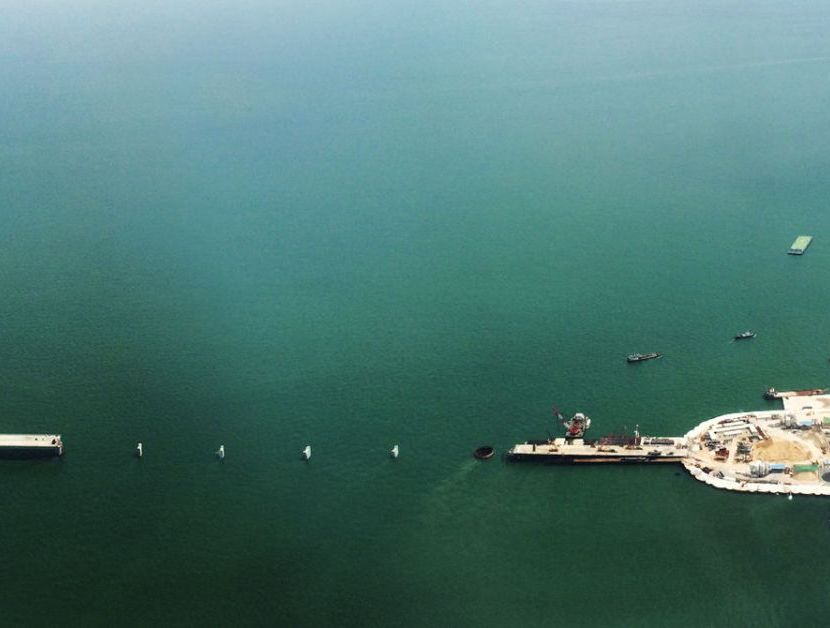
Six years in, we don’t know when Macau bridge will open

bridge

C.Y. Leung’s visit to Zhuhai last week confirmed what has been apparent for months – the grand project to build a bridge across the Pearl River mouth is so far off schedule no-one can say when it will be finished.

At the start of the year the 50-km bridge was slated to come into service by the end of 2016 as originally planned.

In January the government took a request to LegCo for an extra $5.46 billion, and acknowledged it was waiting on a fresh analysis from the Highways Dept to give a revised timetable.  Officials had no trouble in finding reasons for the spike in budget: the high number of construction projects, machinery costs, rising wages, the environmental assessment, the delay caused by the 2010 judicial review and the cost of the new immigration facilities.

In March the head of the Guangdong Development and Reform Commission, Li Chunhong, told the SCMP that construction, which began in December 2009, may not complete until after 2020:

 The bridge was scheduled to be completed next year, but Li said even 2020 was a difficult target because of technical difficulties in laying sections of tubes on the seabed and joining them to make a tunnel.

Continue reading

Barely broadband

Hong Kong’s digital divide is so wide that the outlying islands internet service barely qualifies as broadband.

A survey by the Islands Broadband Concern Group survey has found that the average broadband downlink on the islands is just 4.59 Mbps – less than one-twentieth of the SAR average of 92.6 Mbps (NB: I set up the ISCG and conducted the survey).  Akamai, the company behind the State of the Internet reports that list broadband speeds around the world, has declared broadband to be 4 Mbps and above, with high-speed broadband starting at 10 Mbps.

The online survey also confirmed widespread unhappiness over the residential broadband service: 82% of respondents were either dissatisfied or very dissatisfied; just 8% were satisfied.

Now this isn’t a scientific survey, but it does bring some credible figures that will be difficult for the operator and the government to shrug off.  Continue reading

A short history of Lantau roads

Lantau might have some of Hong Kong’s oldest settled communities, but it wasn’t until the middle of the 20th century that modern roads came to the island.

Historically Lantau people were seafarers and farmers who lived on or near the coast. Any contact between villages was by sampan or mountain path.

That was true long after the island came under British control.

In 1950 a colonial district officer, Austin Coates, advised that a road connecting the southern coastal villages Mui Wo, Pui O and Shek Pik was “urgently needed.” Continue reading