
Category: Roads

A north Lantau-Mui Wo transport tunnel is back on the agenda
A road or rail tunnel – or both – linking north Lantau to Mui Wo is back on the planning agenda, nearly two decades after being rejected on environmental grounds.
A CEDD study on residential development at Siu Ho Wan, east of Tung Chung, discusses the options for building one or both tunnels through the Lantau North Country Park to support future population growth.
It says the Siu Ho Wan development on reclaimed land would house more than 9,000 people, while the expansion of Tung Chung is forecast to add another 170,000 in the next ten years.
The study, by engineering firm Ove Arup, says the route of any new north-south transport connections would depend on the design of the East Lantau Metropolis (ELM). (Notably the study began in 2015 while the ELM was still being discussed by LanDAC.)
The report canvasses two railway tunnel routes to Mui Wo – one from Siu Ho Wan and the other from Tung Chung East station, due to come into service in the mid-2020s.
It says the route from Tung Chung East would be the most feasible, with fewer engineering issues, a lower cost and a direct interface into the MTR system.

Two possible rail routes (Source: CEDD)
The study also considers possible road tunnels to Mui Wo, suggesting the most practical point would be adjacent to the sewage treatment works.
But the potential route faces a number of constraints, including archaeological and scientific sites at Tai Ho Wan, the North Lantau Country Park and the marshes and freshwater sources around Mui Wo.
It says that with the extra population in Tung Chung and Siu Ho Wan, traffic volume on the North Lantau Highway would go beyond the “manageable degree of congestion” after 2031.
The contentious HK$400 billion ELM, built on 1000 ha of reclaimed land in the waters between Lantau and Hong Kong Island, will not be ready until at least the mid-2030s.
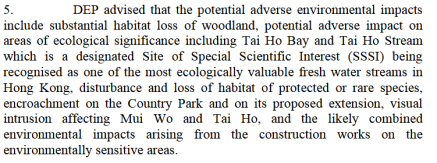
In 2000, the Transport Bureau recommended building a tunnel from Tai Ho Wan to Mui Wo instead of widening Tung Chung Road, at that point a narrow one-lane road.
In a decision unimaginable today, this was overturned by the-then Director of Environmental Protection and instead the widening of Tung Chung Road went ahead.
As the Transport Bureau explained:
The Siu Ho Wan study follows another CEDD report which examines the options for rail and road links from Tuen Mun through northeast Lantau to the ELM and Hong Kong Island.
Separately, the government is seeking HK$88 million for a feasibility study on a freeway from North Lantau to Yuen Long, a plan derided by opposition law-makers as a way to take vehicles to the ELM rather than fixing New Territories transport congestion.
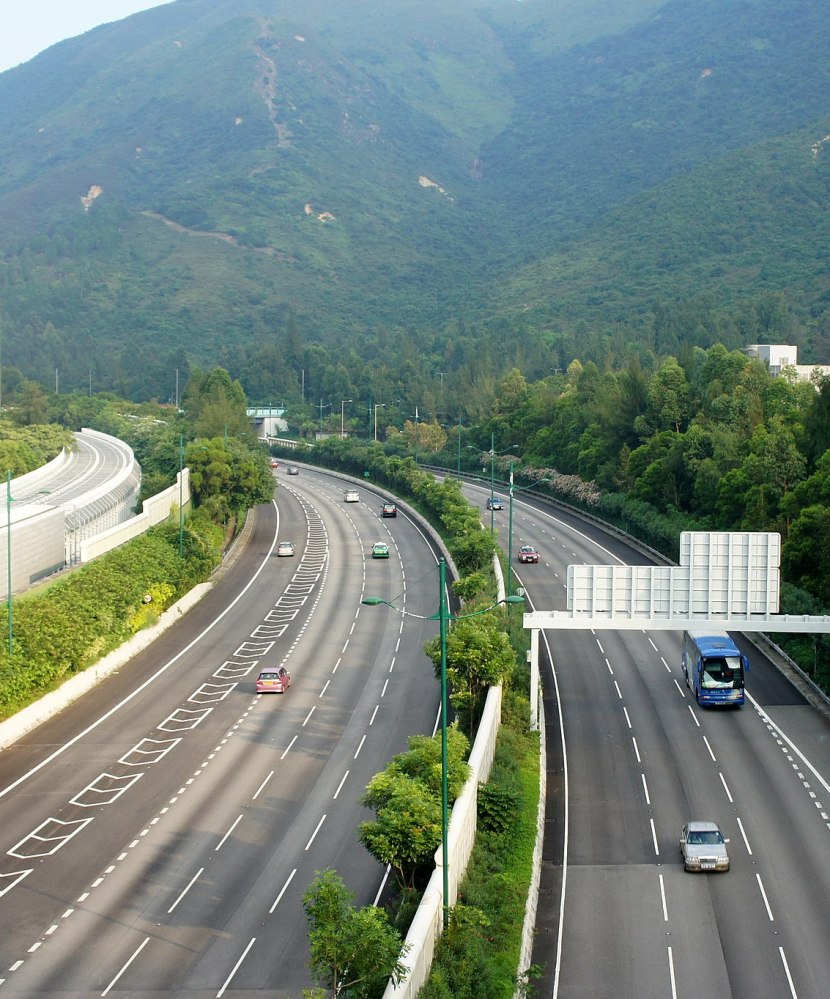
Photo (top): Tai Ho Wan
‘Nonsense!’ Pan-Dems attack plan for third N. Lantau link to Kowloon
Yet another huge and hard-to-justify road project may be headed Lantau’s way.
With work yet to be completed on the HK-Macau bridge and the Chek Lap Kok-Tuen Mun link, the government is seeking HK$87.7 million for a feasibility study on a freeway from North Lantau to Yuen Long.
Legislators said the proposed Route 11, which would connect from Sunny Bay across the strait to Tsing Lung Tau, was identical to the ‘Route 10’ scheme put forward in 1997 and that Legco ultimately rejected in 2004, Inmediahk.net reported.
Under the original plan, the freeway was to run to Lantau’s south coast and then across central waters to reclaimed area around Kau Yi Chau and the west end of Hong Kong island – an earlier version of the East Lantau Metropolis (ELM).
Kwok Ka-ki, Civic Party member for New Territories West, described it as “nonsense,” and said it was intended solely to bring traffic onto Lantau for the ELM, which is not yet approved but is slated for mid-2030s.
Kwok said documents submitted to the Legco public works sub-committee showed that the government was bent on implementing the ELM.

Highways Department ‘indicative plan’
He said the next step would be the government declaring that there was “no way” that the project could be rejected.”
Labour Party’s Fernando Cheung also attacked the proposal.
The government had said NT West needed road links to urban areas, he said. “How is Lantau an urban area?”
The two pan-dems also pointed out that the project should be specified under the Hong Kong 2030+ plan, which won’t be issued until next year, and called on the government to clarify its plans.
DAB member and Islands District Councillor Holden Chow said he believed Lantau needed more road connections to Kowloon and Hong Kong, but the Route 11 plan would only make the Tsing Ma area a bottleneck.
If approved, the bridge-freeway would be the third road link between Lantau and the Kowloon Peninsula.
Currently, the sole connection is through Tsing-Ma Bridge, built in the 1990s to service the airport.
One of the reasons cited for the need for Route 11 is to provide an alternative, for occasions such as the Kap Mun Shui Bridge collision in 2015 which cut road links to the airport.
But the link from the airport to Tuen Mun, part of the HK-Macau bridge project and due to complete in 2020, is already an alternative land route.
Henry Sin, a researcher for Kwok Ka Ki, has said the original proposal, known as Route 10, was estimated to cost HK$35 billion. Writing for HK01 earlier this year, he said the Route 11 was likely to cost at least twice that.

Closed road: daily quota may be doubled
The Transport Department is considering doubling the number of private vehicles allowed into South Lantau each day.
Since February 2016, up to 25 private cars and 40 tourist buses have been permitted into the Lantau closed road area each weekday.
Now, because of what the department regards as the success of the scheme, it is planning to increase the quota to 50 cars and 50 buses, Sing Tao reports.
The paper notes that, apart from the requirement that five of the 25 private cars be electric, the private vehicle quota is full almost every day for the next month.
The proposed higher quota takes the TD back to its original plan, floated two years ago, of allowing 50 cars and 50 buses in daily.
It trimmed the numbers for the start of the scheme following an outcry from the local residents.
Chau Chuen-heung, a former DAB district councillor and now vice-chair of the Lantau Development Advisory Committee’s transport group, said that because the vehicles can only enter Lantau between 8 am and 7 pm on weekdays, they would avoid the weekend crowds.
She said the district’s concerns were over the lack of parking spaces.
However, besides the limited parking facilities, local residents are also anxious that once the closed road was lifted, the number of vehicles would continue to rise under pressure from local businesses and rural leaders.
With news of a plan to hike the quota, those fears have not been allayed.

Epic typhoon traffic jam sent passengers scurrying for MTR
Typhoon Khunan brought more than wind and rain to Hong Kong yesterday – it also helped create a massive traffic jam.
Traffic control measures on the Lantau Link caused vehicles heading to the airport and Tung Chung to back up as far as Stonecutters Bridge and Sham Tseng.
The result was rare scenes of people abandoning their rides and walking to the Tsing Yi and Disney MTR stations in order to catch their flights.
The traffic jam, which at one stage reached 13 kilometres long, followed the closure of the Tsing Ma and Ting Kau bridges. Vehicles were diverted to the lower deck of the Tsing Ma, causing drivers to be delayed in traffic for up to four hours, Apple Daily reported.
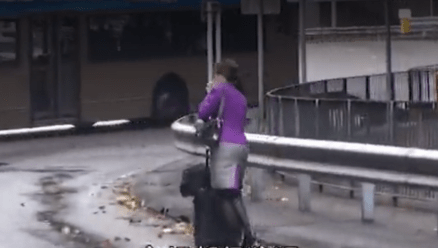
Flight attendant continues on foot (Photo: Apple Daily)
Secretary for Transport & Housing Frank Chan called for public understanding over the traffic controls, which were intended to ensure public safety. He told reporters restrictions were introduced only when the wind speed on Tsing Ma or Ting Kau bridges exceeded a specified level.
It was the second major traffic jam on the Lantau Link in two months. Drivers were delayed for several hours when the two-way toll was introduced in August.
The T8 storm signal was raised for 11 hours yesterday, in which time 479 flights were delayed and 79 were cancelled, according to Apple Daily.
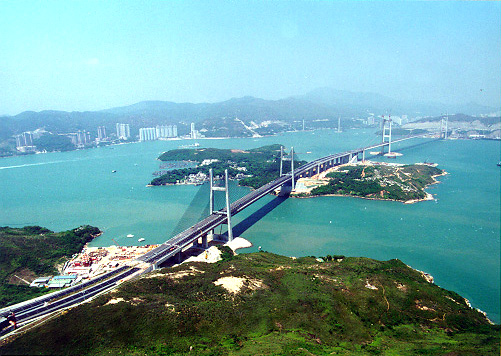
Photo (top): Traffic banked up behind Ting Kau Bridge
Govt apologises over tollbooth congestion, increases capacity
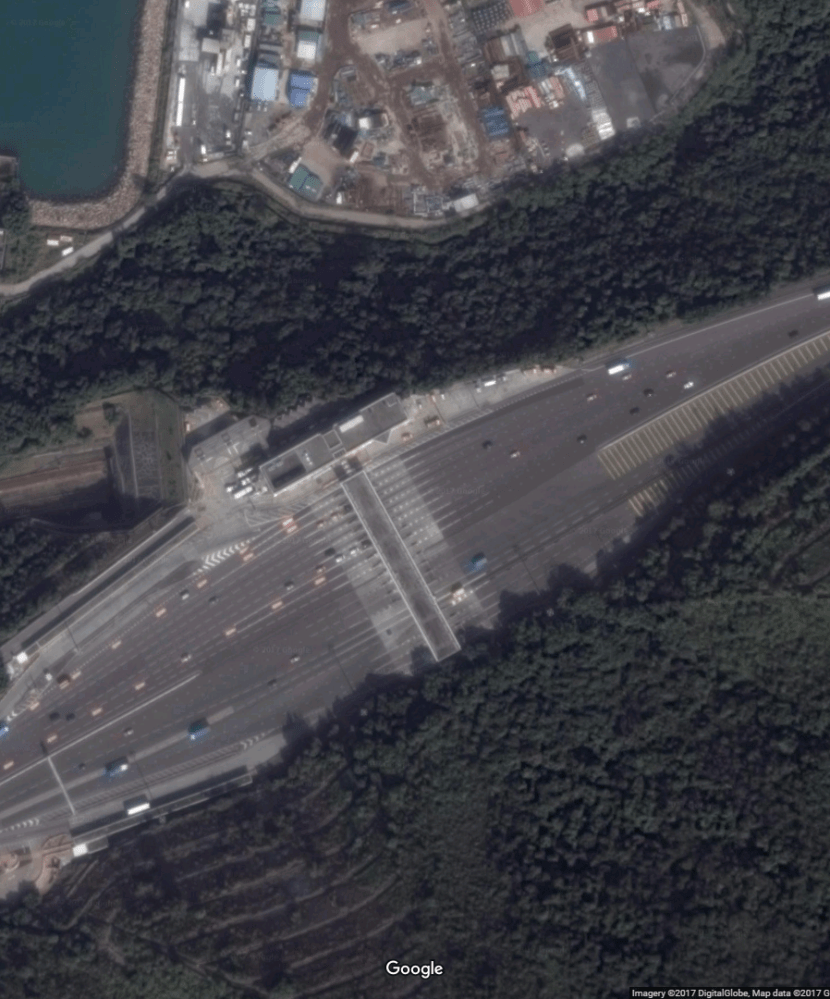
Traffic at the Lantau Link tollbooths has returned to normal after yesterday’s chaotic opening day.
Acting Transport Commissioner Macella Lee has apologised over the congestion and has added extra booths at the toll plaza.
Traffic backed up as far as Tsuen Wan and the Tai Lam Tunnel on the first day of the two-way toll, introduced ahead of the opening of the Hong Kong-Zhuhai-Macau Bridge in the coming months.
In a press conference after visiting the site yesterday, Lee acknowledged there was room for improvement in preparation for the switch to two-way tolls. RTHK reported.
“The way the barriers are put and the traffic signs for the motorists can also be improved,” she said. Lee said the department has also increased the number of booths to six, from the four that operated in the morning.
The Transport Department said it would closely monitor traffic around the tollbooths.
Traffic cams at the Lantau Link Plaza and Kap Shui Mun bridge this morning showed no sign of congestion.
Traffic chaos: Cars backed up for miles in botched two-way toll launch
Lawmakers have called for the suspension of the two-way toll on Lantau Link expressway after a chaotic first day of operation.
Vehicles were backed up for hours in the westward lanes today after imposition of the new toll from early this morning.
The congestion is caused by the lack of toll booths, with the Transport Department clsoing off booths in five airport-bound lanes until December.
Ben Chan, chairman of the Legco Transport Panel, attacked the Transport Department for underestimating the traffic flow. He called on the department to suspend the two-way toll until all the facilities were ready. According to RTHK:
The Tsing Ma Bridge, Tai Lam Tunnel, and even Tuen Mun Road became almost paralysed in the direction of the airport for a number of hours on Monday morning, as tailbacks spread further and further back from the Lantau Link Main Toll Plaza.
A number of toll booths there are still not fully constructed and several approach lanes are closed.
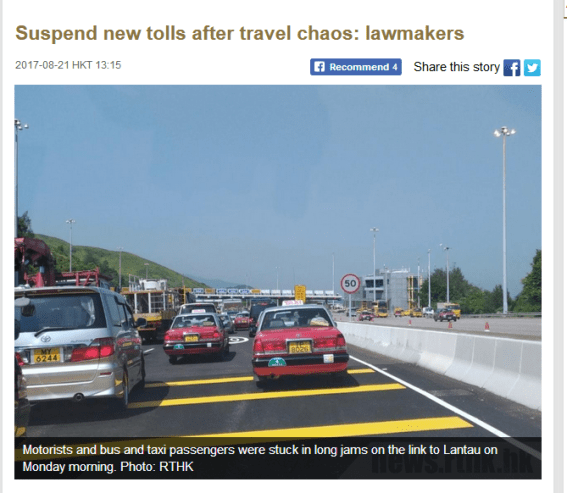
RTHK photo of the westbound queue this morning
Chan, a DAB member, said the Transport Department planned to open another two toll booths on Tuesday, but he believed that would not be enough to alleviate the congestion.
“This morning I drove from Yuen Long to Tsim Sha Tsui and passed the link. I got jammed there for more than half an hour. I think this arrangement is not so clear for the drivers,” he said.
Democratic Party lawmaker Andrew Wan warned that traffic on the Lantau Link could be paralysed next month when students go back to school after the summer holiday.
Chief Transport Officer Wendy Leung suggested drivers’ lack of familiarity with the new arrangement might be causing them some time to find the cash to pay the toll.
The new arrangement, introduced ahead of the opening of the Hong Kong-Zhuhai-Macau Bridge, means car drivers pay HK$15 in each direction rather than HK$30 on the eastbound lane only.
Two-way tolls for N. Lantau freeway from next month
Drivers will have to pay tolls both ways on the North Lantau freeway from August 20, the Transport Department has announced.
The change is to accommodate the opening of the Hong Kong-Macau Bridge, after which the Lantau freeway will no longer be the only road access to Lantau.
The Transport Department said in a statement Wednesday that a two-way toll collection arrangement will be implemented at the Lantau Link Main Toll Plaza and the Ma Wan Toll Plaza from midnight on August 20.
The total toll charge won’t change. Private vehicles heading toward Kowloon, who currently have to pay HK$30 at the Lantau Link tollbooth, will pay HK$15 each way.

Silvermine Beach river crossing to be upgraded to twin bridges
The Wang Tong River bridge on Silvermine Beach is to be replaced by separate pedestrian and cyclist bridges under a Highways Department plan.
The existing 1.5-metre wide bridge will become a 35-metre long crossing comprising a 3.5-metre wide bikeway and two-metre wide pedestrian path.
In a submission to the Islands District Council traffic and transport committee the department said the current bridge is frequently congested “when both the local residents and tourists use [it] simultaneously.”
“The lack of segregation also raises road safety concerns as pedestrians, cyclists and village vehicles may come into conflict with each other during peak periods .”
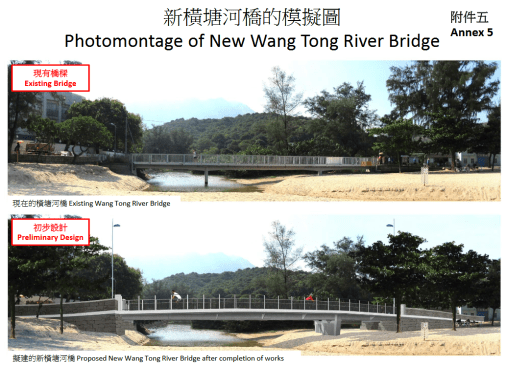
Source: Highways Dept
The department does not put a price tag on the twin-bridge project, but warns it will mean temporary closure of the existing bridge during different phases of construction.
It also does not specify how long construction will take but the environmental assessment report filed by the Environment Protection Department in 2013 said it would be approximately two years.
The project is the latest in the Mui Wo Facelift programme that has been underway for the past decade.
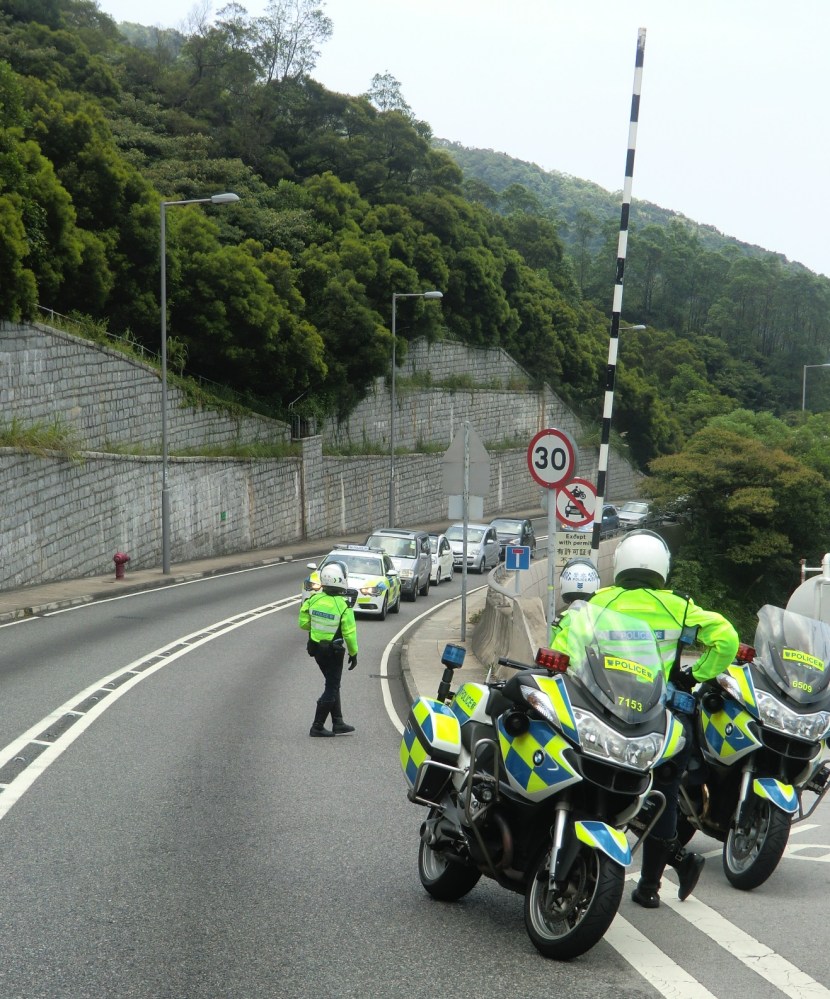
Road wars: Lantau closed road must go, says Randy Yu
Lantau’s road wars continue. District council member Randy Yu has attacked the closed road, describing as out of date and “highly unreasonable.”
In the latest volley in a continuing battle over the island’s roads, Yu has called on the Transport Dept to cancel the fee charged for the annual permit.
Yu, the South Lantau representative and vice chairman of the Islands District Council, told the council’s transport committee that despite the growing number of visitors, Lantau is stuck with a road network built more than half a century ago.
“The closed road is out of date, but still exists,” he said. “The operation of the existing Lantau Closed Road Permit system is highly unreasonable.”
Additionally, the imposition of the annual permit fee of $660 is cumbersome and excessive and denies residents’ relatives and friends “the right to drive” to Lantau to visit, he said.
His remarks at the transport committee’s March meeting follow a similar call by Tai O rural committee chairman Lou Cheuk-wing in February.
Yu complained that the rural committee leaders and Legco members had proposed on numerous occasions the expansion of the existing road network, but the government had refused to build it. Environmentalists and many local residents are also opposed to the expansion.
Lantau’s rural committees want to create a round-island road network, upgrading South Lantau Road to standard grade and adding a coastal connection from Tung Chung to Tai O and a north-south link from Tung Chung to Mui Wo.
The Transport Dept and, more recently, the LanDAC committee, which was set up to plan Lantau’s future, have rejected both roads on cost and environmental grounds.
In January last year the Transport Dept lifted the ban on non-local vehicles, allowing up to 25 cars and 40 tourist coaches a day to visit the island. Police reported that in the first six months following the change, traffic offences soared 150%.
(Photo: Lantau drivers protest against the lifting of closed road restrictions in July 2015.)
North Lantau freeway to charge toll both ways
The bad news is motorists will have to pay a toll in each direction on the Lantau Link freeway. The good news is it won’t cost any more.
The new rule will take effect on December 15, a result of the opening of the Hong Kong-Zhuhai-Macau bridge, also expected at the end of the year.
The current toll of $30 is in fact the two-way toll, but it is charged once once because virtually all traffic on the road is two-way.
That will change with the arrival of the bridge, which will allow drivers to head for destinations across the Pearl River.
However, it won’t change for taxis. To ensure they won’t be discouraged from airport pickups, they will still be permitted charge a HK$30 surcharge both ways.
 Lantau Confidential