
Category: development

East Lantau Metropolis will be nearly as large as airport

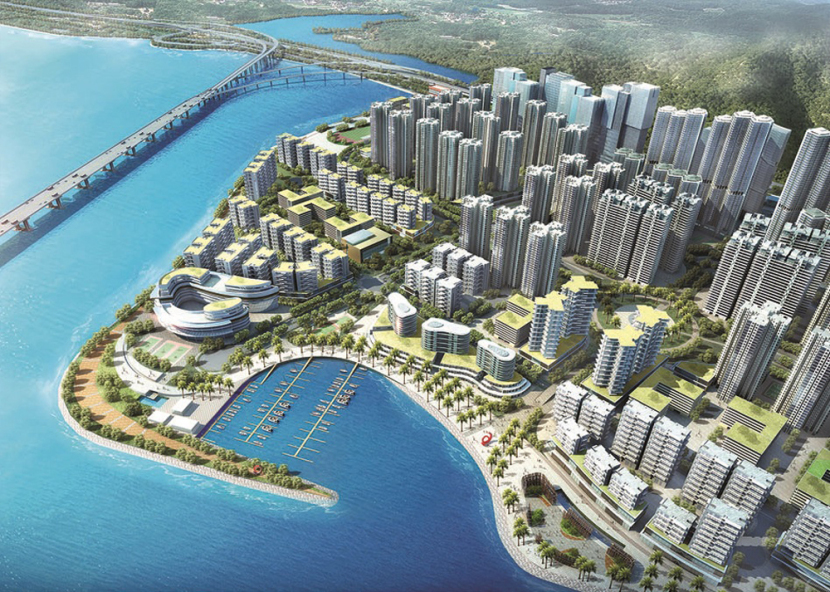
A site for flyovers: Kau Yi Chau
The East Lantau Metropolis (ELM) will require reclamation of around 1000 hectares in Hong Kong central waters, activists have calculated.
That is equivalent to roughly 1,000 rugby fields and compares with the 1,200 ha Chek Lap Kok Airport and the 130 ha artificial island for the Hong Kong-Macau Bridge landing zone.
Those are the estimates from conservation group Save Lantau Alliance, based on close observation of the infamous 3D model of the ELM in Paul Chan’s office. Continue reading
What do Lantau rural leaders want? Roads
If there’s one thing Lantau’s rural representatives agree on it’s roads.
They are urging construction of two roads in particular: a northwest coastal road from Tung Chung to Tai O, and a north-south link from Pak Mong, just east of Tung Chung, to Mui Wo.
The coastal road was canvassed in the early LanDAC plans – as was a road from Tai O to Fan Lau – but was rejected, either for reasons for cost or conservation. The north coast, which hosts villages such as San Tau and Sha Lo Wan, includes coastal wetlands and natural streams and habitat for butterflies and diverse rare species.
Randy Yu, Islands District Council vice-chairman and newly-elected member for South Lantau, complained that “authorities have never thought about a long-term transport strategy” for Lantau. Continue reading
Lantau development will bring ‘uncontrollable eco-vandalisms’
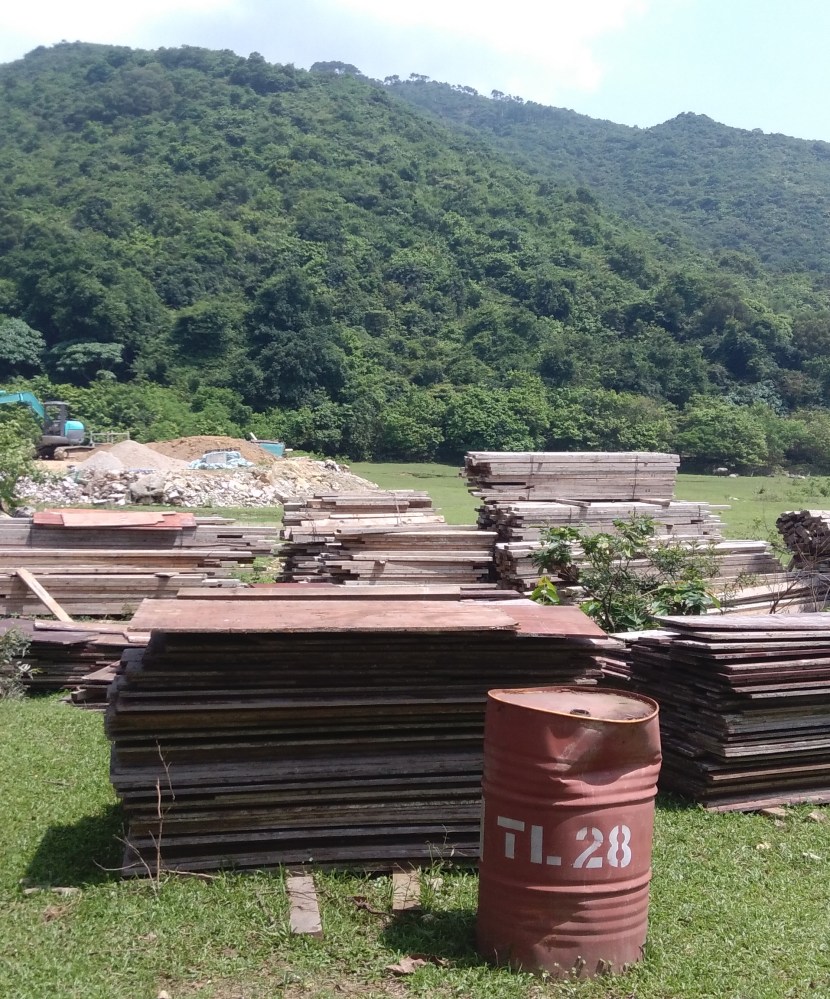
This blog has finally got around to trawling through the submissions to the LegCo hearing on Lantau development in April. First up: environmental groups warn the government’s development programme will lead to “uncontrollable eco-vandalisms” because of the lack of zoning protections and weak enforcement.
In a joint submission, five green NGOs say they are “deeply concerned” by the development-centric model that does not provide adequate protection for important conservation sites.
They point out that the island has “exceptionally rich biodiversity,” including the Chinese White Dolphin, the finless porpoise and Romer’s Tree Frog, among others. “However, the deficiency in enforcement capabilities due to loopholes in existing legislation has rendered Lantau vulnerable to environmental vandalism,” they warn.
This is because, under the Hong Kong approach to land use and conservation, a site can only be protected if it is designated as a development site, known as a Development Permission Area (DPA). To give a prominent example: the South Lantau Coast Outline Zoning Plan (OZP) was published in 1980 yet has not been covered by a DPA plan.
As a result, eco-vandalism has been proliferating with impunity on private land, including ecologically important wetlands in Pui O. With such a loophole in statutory control under the Town Planning Ordinance, the future economic activities stimulated by the proposed developments and the ease of access caused by the relaxation of closed roads would lead to uncontrollable eco-vandalisms and further encroachment on unspoiled natural habitats.

The paper lists 16 species or habitats that are of conservation concern, including Yam O and Sunny Bay wetlands, Tung Chung Valley, Tung Chung Bay, the northwest Lantau coast and Tai O.
It says areas without statutory protection should be designated with DPAs or incorporated into the Country Park system “without delay” because of the imminent development pressure. DPAs should be applied urgently to rural areas already covered by OZPs, such as the Pui O wetlands.
The five NGOs – Designing Hong Kong, Green Power, Hong Kong Bird Watching Society, The Conservancy Association and WWF Hong Kong – also call for the continued enforcement of South Lantau’s closed roads, urging the adoption of public and environmental-friendly transport rather than private cars.
Any new roads should be well justified, assessed (in the context of environmental impacts and cost effectiveness) and publicly consulted. Green Groups opine that no new roads should be planned in Country Parks, South Lantau and Tung Chung Bay, and near or in other ecological important sites.
They also urge the establishment the West Lantau Marine Park in the waters off Yi O and Tai O to connect all the Marine Parks around Lantau. This would reduce the impact on dolphins of the rush of development projects by safeguarding their remaining habitats and preserving travelling corridors.
The submission was endorsed by 21 other NGOs, including Ark Eden, Friends of the Earth, Greenpeace East Asia and Living Islands Movement.
Lantau development will bring “uncontrollable eco-vandalisms”
This blog has finally got around to trawling through the submissions to the LegCo hearing on Lantau development in April. First up: environmental groups warn the government’s development programme will lead to “uncontrollable eco-vandalisms” because of the lack of zoning protections and weak enforcement.
In a joint submission, five green NGOs say they are “deeply concerned” by the development-centric model that does not provide adequate protection for important conservation sites.
They point out that the island has “exceptionally rich biodiversity,” including the Chinese White Dolphin, the finless porpoise, and Romer’s Tree Frog, among others.
However, the deficiency in enforcement capabilities due to loopholes in existing legislation has rendered Lantau vulnerable to environmental vandalism.
Explains a lot: Lantau is central to Leung’s reelection
Zhang Dejiang’s short visit (or inspection) has told us that Lantau is not just a big deal in Hong Kong. It’s a pretty big deal in Beijing, and an even bigger deal for CY Leung’s reelection (or ‘reelection’) strategy.
The Development Bureau was the first place on Zhang’s official agenda, which soon became well-known to Hong Kong thanks to this photograph of the VIP inspecting this hefty 3D visualisation of the Lantau plans:
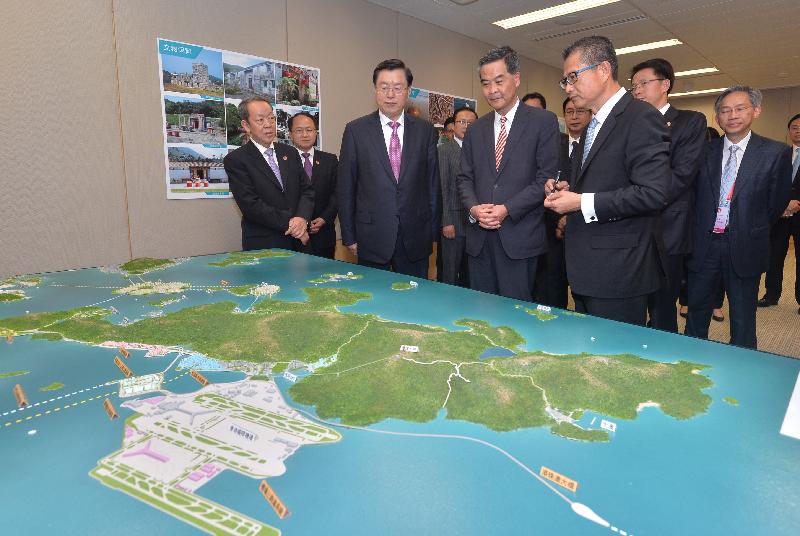
Suits meet the model (Source: Development Bureau)
A couple more for the banner collection
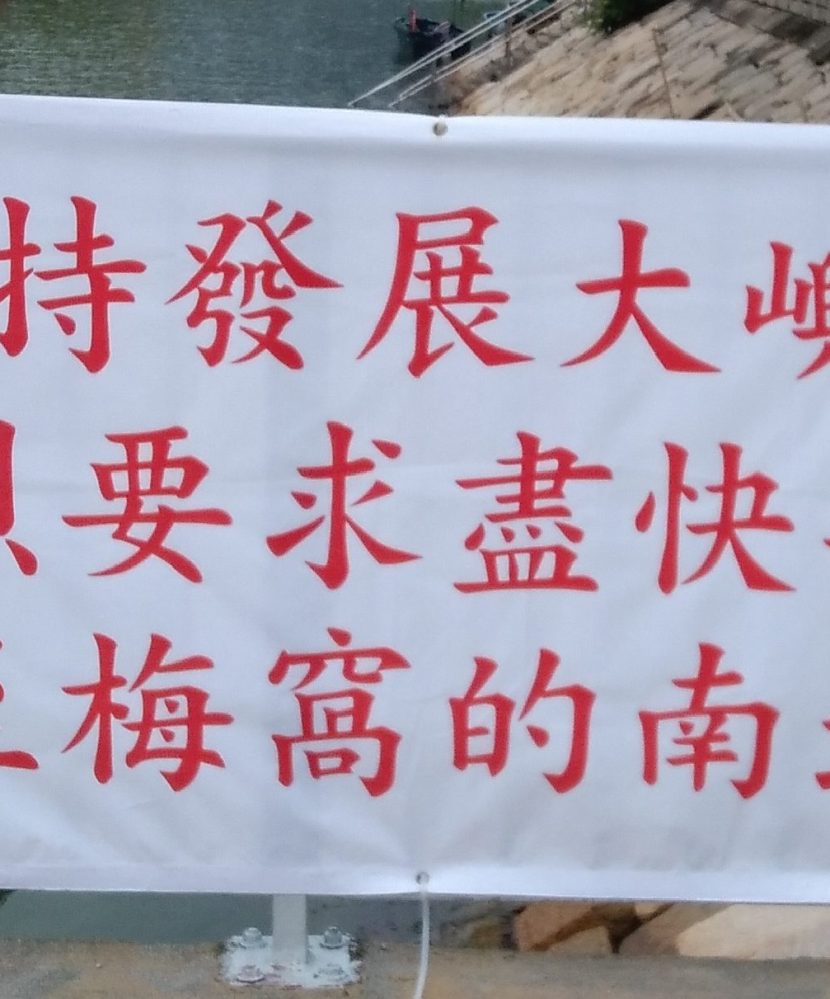
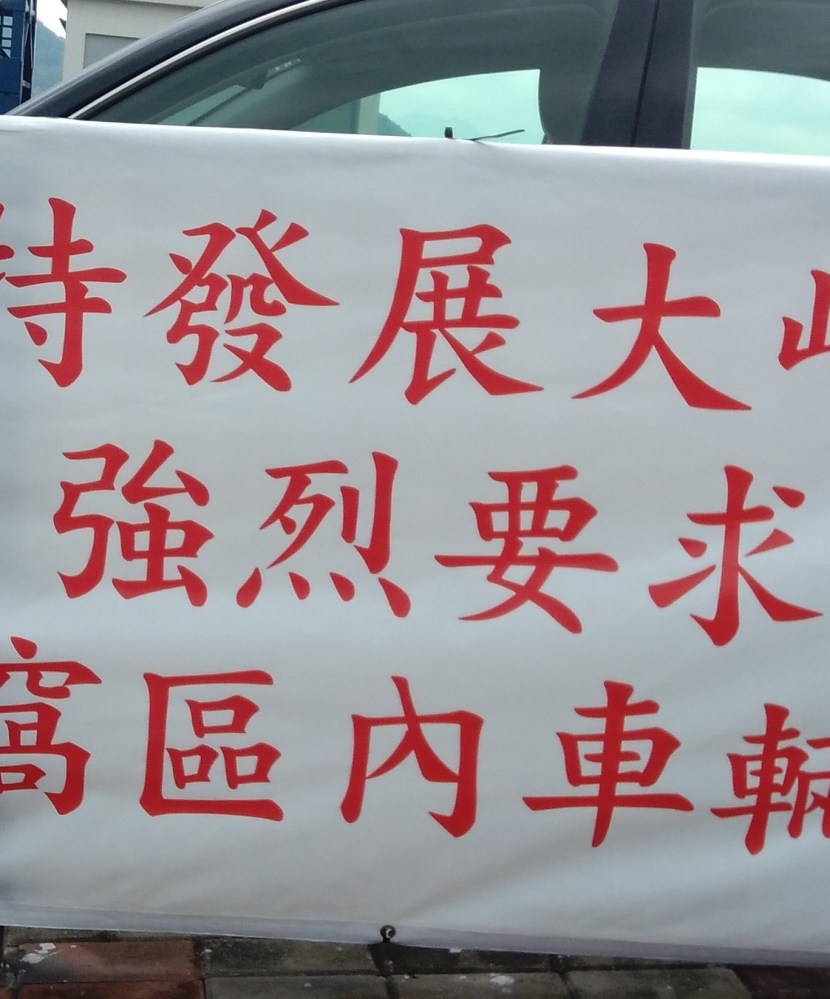
For the record, a couple more banners next to the Mui Wo ferry pier.
Resident Ben Sargent commented on my earlier piece that banners calling for the redevelopment of Chi Ma Wan prison are up in the Ham Tin/Pui O area. So whoever is doing it is reasonably thorough. And also, you’d have to say, a touch conspiratorial and counter-productive. What’s the point of making an intervention in local issues if you’re not going to identify yourself?
As posted earlier, one resident claims to have seen former local District Councillor Rainbow Wong and a team putting up the banners in Pui O.
There is no sign the banners have been approved by the Lands Department. Local environmental activists say they must apply months in advance to get just a single banner space.
Anonymous banners getting govt message out on Lantau development
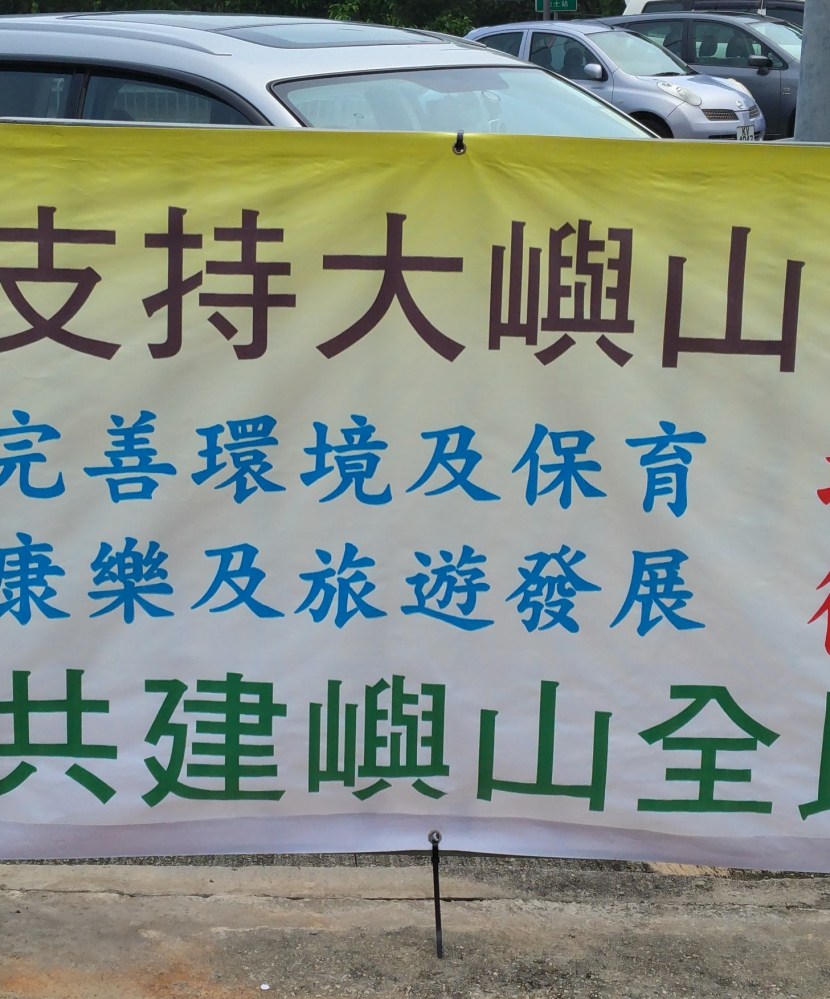
A series of banners promoting the government’s ‘develop Lantau’ message have popped up all over South Lantau in the last three days. The unusual feature is that no one has put their name to them.
What’s also unusual is that, unlike the government grand plan that includes inflatable water toys, cable cars and artificial islands, these messages include practical ideas that could improve people’s lives, like better internet and a functioning sewage system.
That said, these promotions are on the same page with the government on conservation, with one banner asserting that environmental protection should not take precedence over development.
Photos and translations of ten of the banners below.
(UPDATE: One Pui O resident posted on a local Facebook page that she’d seen former Islands District Councillor Rainbow Wong hanging the banners. Wong was the preferred Rural Committee representative for a decade until the local powerbrokers threw their weight behind Randy Yu at last year’s election. )
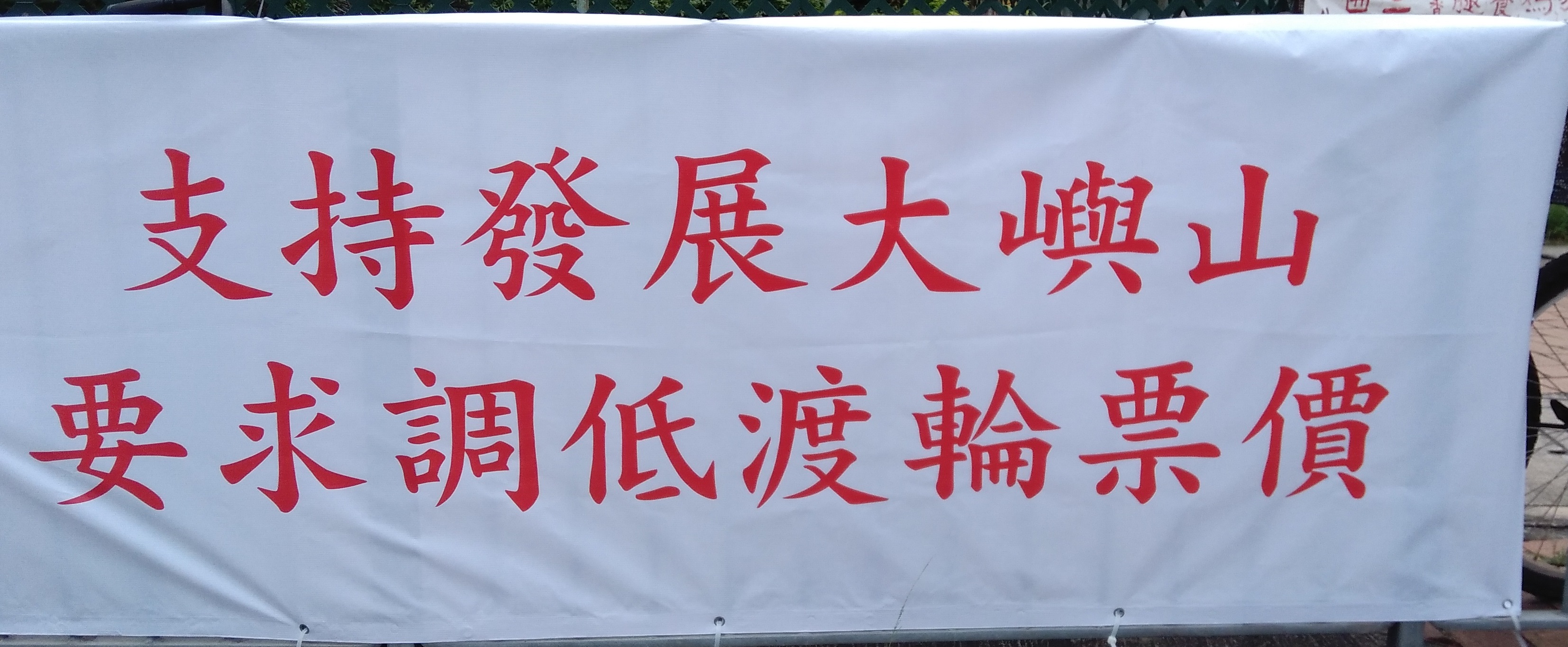 ‘Support Lantau Development: Cut ferry ticket prices’ – Mui Wo roundabout Continue reading
Rethinking Lantau development
Highlights from submission to the Development Bureau (full submission here).
No Vision, No Data, No Conservation
The decision-making process on Lantau’s future appears to be explicitly designed to exclude community input. From day one LanDAC membership has been almost wholly drawn from the real estate, tourist and logistics industries, along with government political supporters and appointees. The public rightly doubts the genuineness of this ‘consultation.’
The government plan offers no vision for the island: what will it be like to visit, live or work in Lantau in 2026, 2036 or beyond? The report doesn’t say. At the same time it tries to micro-manage tourist development in ways that are counter-productive. Continue reading
Declare independence, save Lantau
Public consultation (or ‘consultation’) on Lantau development is in its final week. On recent evidence it is difficult to believe it will make a difference.
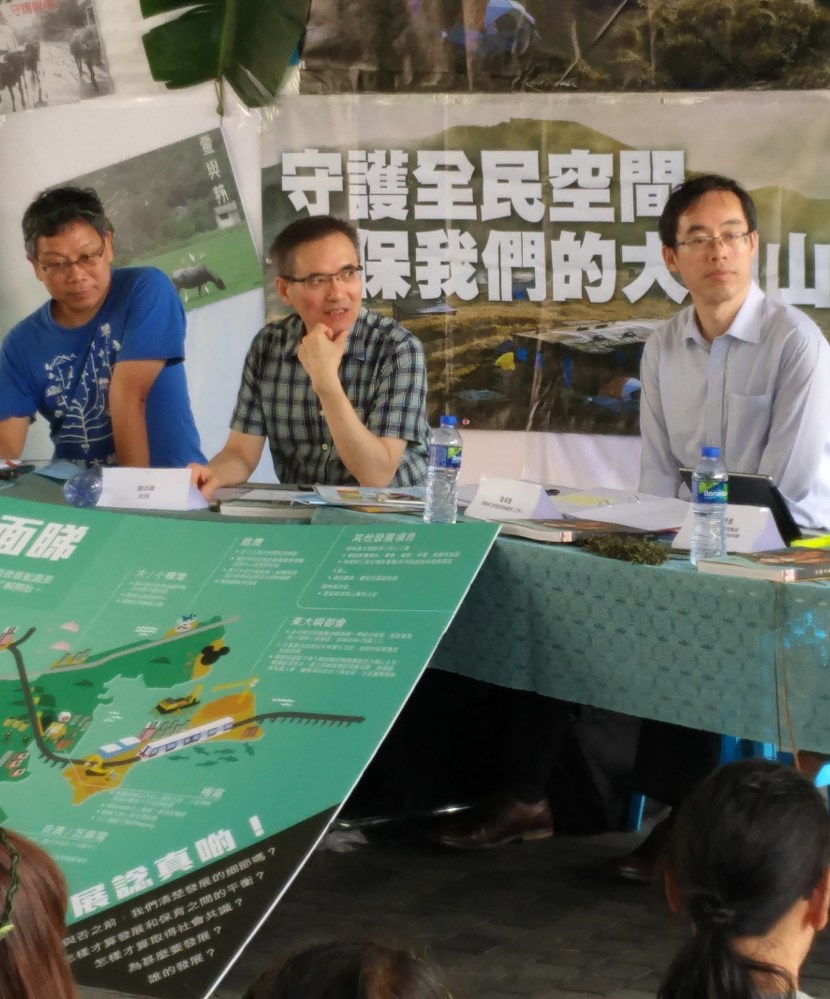
This blog has attended two public forums on Lantau in the past fortnight – one at Hong Kong University and the other one at Pier 8, Central. The way these work is that senior officials turn up, take notes and occasionally answer questions while people tell them what they’re doing wrong. Then they go back to their offices, tick the ‘consultation’ box and life goes on.

Lantau Community Forum, Pier 8
Exhibit A for Lantau is the four years of consultation over the Shek Kwu Chau incinerator that yielded exactly zero changes to the original plan. Continue reading
Sign of the times
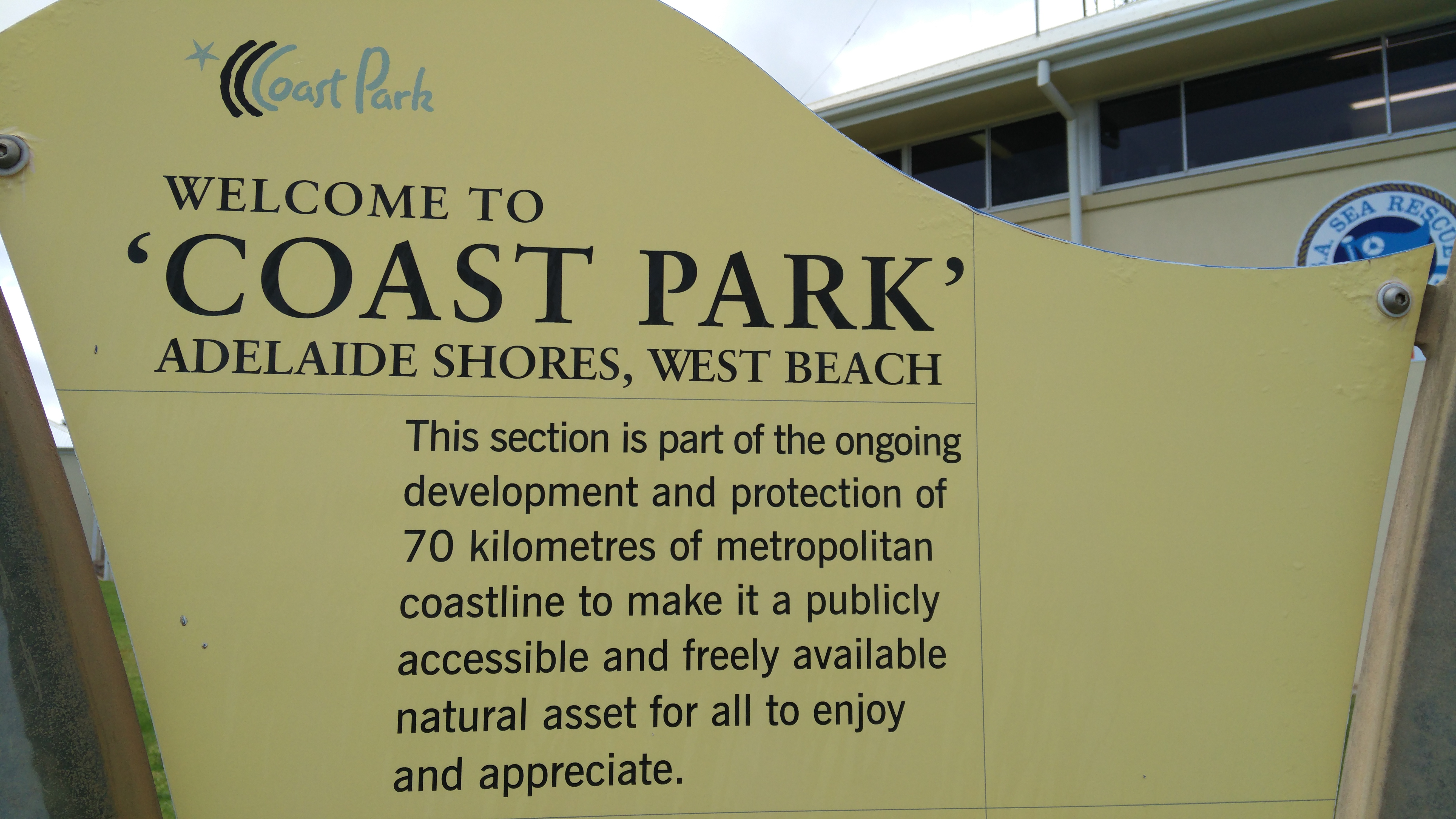
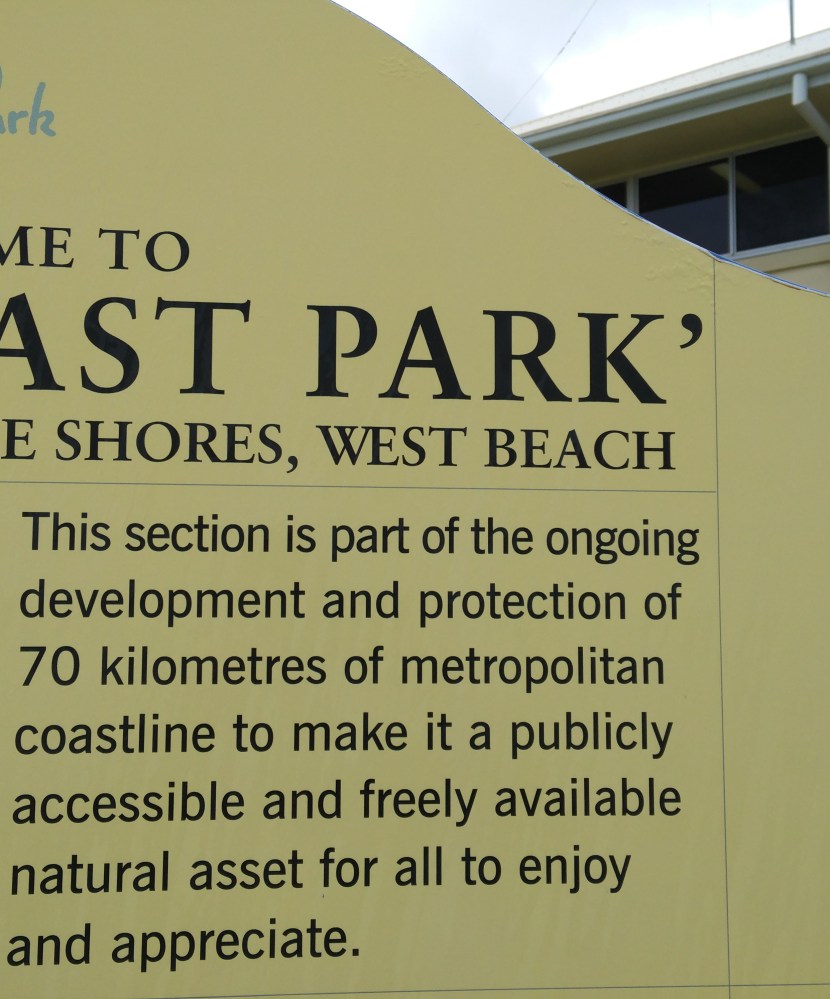
This simple sign contains four ideas totally absent from discussions about the future of Lantau:
- The environmentally fragile coastline should be protected
- It is a natural asset for all to enjoy
- It is important that it should be publicly accessible
- Government should be play an active role to ensure 1), 2) and 3)
What it doesn’t say: the coastline should be turned into a frontline economic development zone to support mass tourism.
 Lantau Confidential