
Tagged: Pui O
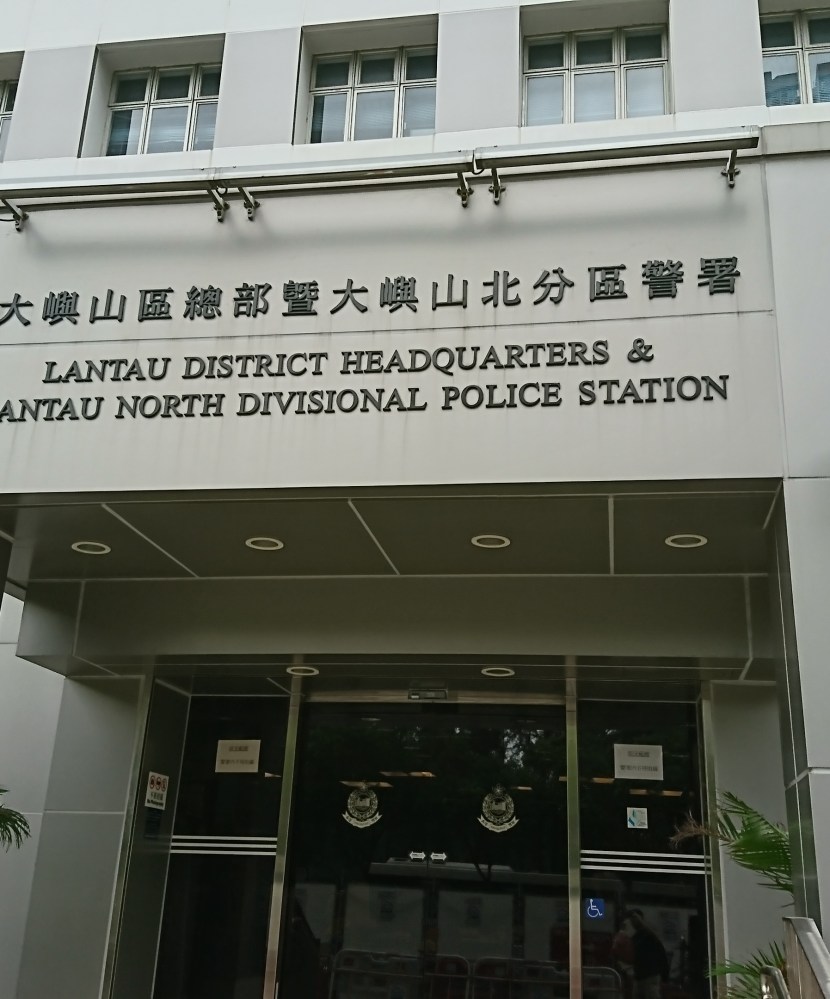
With burglaries up 20%, Lantau police push video surveillance
Burglaries in Lantau are up 20% in the first 11 months of the year, police say, as they promote a video surveillance scheme for local villages.
Lantau District Police Commander Josephine Mak-Lau Wai-mun said the number of criminal cases this year is similar to last year, but burglaries and criminal damage cases have increased from 30 to 49.
Police are now rolling out a scheme called ‘Lantau Eyes’ in which they make use of CCTV owned by villagers to build up an anti-crime network, Apple Daily reports.
Currently nine villages, including Tong Fuk, Lo Wai village in Pui O and Ma Wan San Tsuen in Tung Chung, are taking part in the trial.
CCTV increases the difficulty of making crimes, Lau said. In Sham Shui Po, where she was previously posted, the number of burglaries had fallen by a quarter after introduction of video surveillance.
She said many of Lantau’s 58 villages were in remote locations, while villagers often were not accustomed to locking up at night or when they left their houses.
Mak said the first phase of the scheme would be to make good use of camera already installed by villagers themselves, while police would work with village leaders and rural committees to invest in the equipment.
Said police would have access to the video data only with the consent of the villagers.
Police also would post notices where videos were operating so that member of the public would be aware they were being recorded.
Fan Chi-ping, chairman of the Tung Chung Rural Committee, said it plans to spend $60,000 to $70,000 on video surveillance for its 16 villages.
Across the border, China has deployed AI-equipped 20 million cameras on city streets in the world’s most aggressive video surveillance programme.

Another slice of Pui O wetland under threat
Yet more of the Pui O wetlands is under threat of disappearing.
A landowner is seeking to turn more than 400 sq metres of wetland into agricultural land.
Already an area of approximately 150 sq metres has been covered with landfill.
Although the wetland is officially designated Coastal Protection Area (CPA), that offers no protection.
Under the city’s baffling planning and environmental laws, it can only be protected if it is zoned for development.
Just as inexplicably, the Environmental Protection Department (EPD) can give the go-ahead for landfill. A notice on the Pui O site indicates it has EPD “acknowledgement.”
The owner also has applied to the Town Planning Board (TPB) for permission to change the land use to agricultural.

Michael Lau, director of wetland conservation at WWF-HK, says he has reported it to the EPD “as yet another example of illegal landfilling about which they appear completely unable to do anything.”
Local environmentalists point out that the EPD notice appears to have been erected after landfilling began.
They also express surprise that the EPD has taken the step to approve the landfill while a judicial review (JR) is underway questioning that power and the way it is exercised.
The JR, filed two years ago, has been completed but the judge has yet to deliver a decision.
Additionally, if this part of a conversion to agricultural land, the landowner appears to be in breach of zoning regulations by having begun before the application is approved.
It is the latest of a series of assaults on the Pui O wetland, which is not organic wetland but is abandoned farmland that has been regenerated by the presence of water buffalo.
The buffalo now find their habitat is disappearing, as landowners dumped waste, carried out landfill, converted to farm land or fenced-off wetland areas.
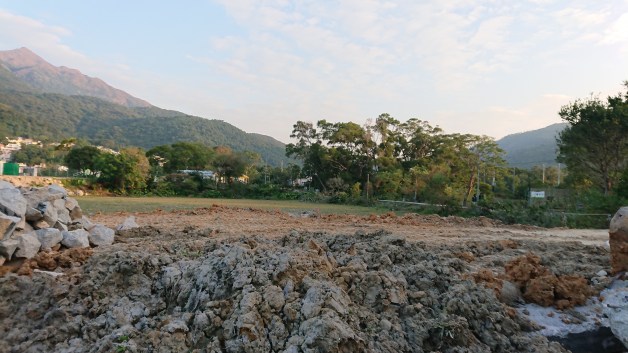
It is made more complex because most of the land is held by private landowners.
There is some support from rural leaders for a land-swap, in which the government would exchange equivalent land for the wetland plots.
But the first such land swap was completed in June in Sha Lo Tung, a dragonfly breeding ground and an area described of “high ecological importance.” Yet that involved a single landowner and still took a dozen years to complete.
In her September policy address, Chief Executive Carrie Lam flagged up “conservation initiatives” in Pui O and other Lantau villages, but gave no specifics.
Those wishing to object to the landfill and conversion of wetland can object to the TPB or write to the Lantau officer plyau@epd.gov.hk or Robin Lee, head of the Sustainable Lantau Office robinkblee@cedd.gov.hk.
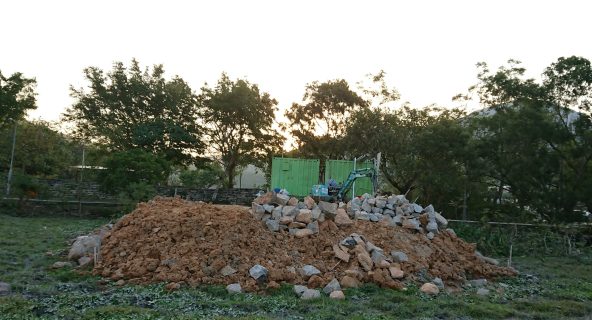

Lantau rural chiefs defy govt with plan to oust cattle and buffalo
The ink is barely dry on the government’s long-term Lantau development plan, but one of its core principles is under challenge from rural chiefs in their latest attempt to expel cattle and buffalo.
The Sustainable Lantau Blueprint, issued in June, calls for the conservation of rural Lantau’s natural and cultural heritage.
It specifically demands the protection of the Pui O wetland, home to the local buffalo herd, which it acknowledges as as “part of [Pui O’s] cultural history” and an important means of showcasing Hong Kong’s rural history. It also seeks the preservation of Mui Wo’s “rural township character.”
However, the Islands District Council and local rural committees are once again lobbying the AFCD to remove Lantau’s remaining cattle and buffalo.
This time their plan is to shift them to Tai A Chau, an island in the Sokos with limited water supplies and no wetland that could support buffalo.
Despite this, the AFCD cattle team is understood to have told an October 12 meeting that the plan was feasible. However, they also said the idea was not practical because there was no way for them staff to conveniently reach the remote location.
The meeting, organized by the Islands District Council, was attended by Wong Man-hong and Fan Chi-ping – the heads respectively of the Mui Wo and Tung Chung rural committees – a member of the South Lantao Rural Committee, district councillor Randy Yu, LanDAC member Chau Cheun Heung, Bui O Public School principal Yu Mei Fong, Home Affairs Department officials and four representatives from cattle support groups.
One attendee told Lantau News the rural leaders argued that the move was necessary for safety reasons, although they were unable to explain why the buffalo posed a bigger safety threat than speeding traffic on EVA.
Despite the AFCD reservations, the rural councillors and Randy Yu urged the AFCD to go ahead with a trial.
The current effort to remove Lantau’s bovines is the latest of many.
In one notorious case in 2006, several dozen cattle were removed byAFCD truck to Fan Lau, but only three survived the journey.
In 2013, the AFCD experimented by swapping cattle herds between South Lantau and Sai Kung. One of the Lantau cattle died and many of the remainder, unable to food in the unfamiliar environment, had to be hand-fed. The trial was terminated after the department was hauled before a Legco sub-committee.
In the last two years the plan to remove the animals to Tai A Chau has emerged on a number of occasions, only for the government in each instance to deny it.
An online petition opposing the relocation states:
We believe that Lantau Island has absolutely sufficient capacity for the conservation of all cows and buffaloes. Any form of relocation out of Lantau Island is not needed. In addition, we demand the government to establish a long-term conservation policy, allocating resources to conserve them in their original habitats.
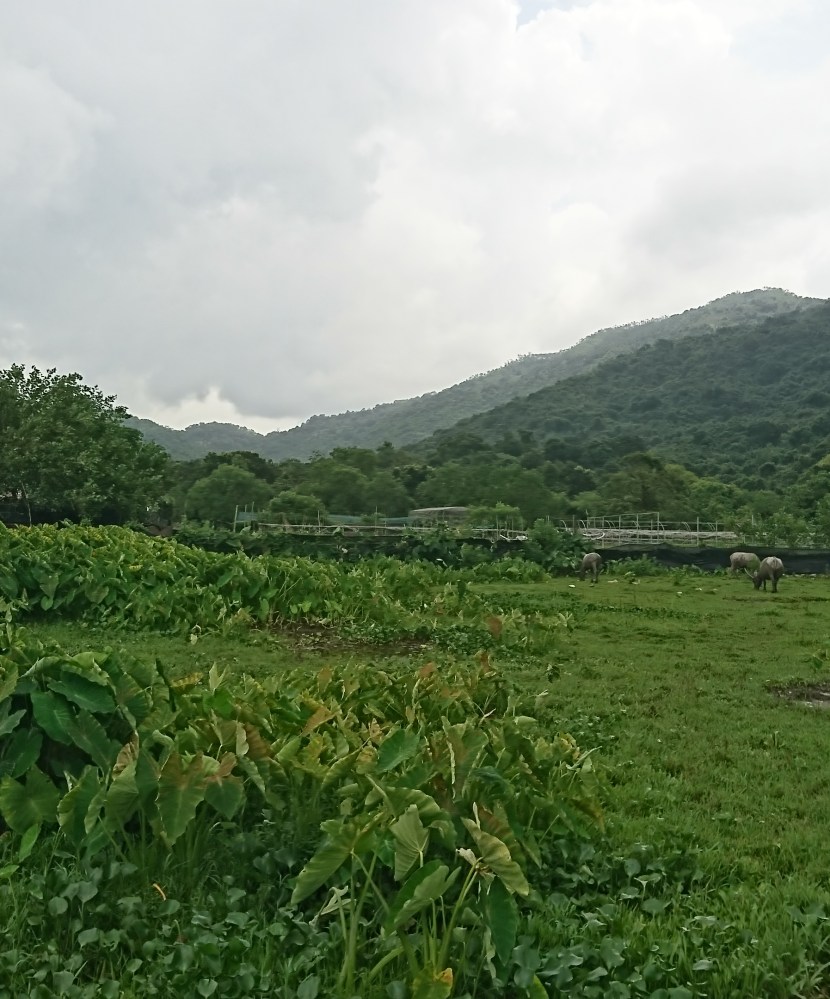
Developer withdraws Pui O caravan park plan
Pui O business group JK Group Limited has withdrawn its application for a caravan park and holiday camp.
The application to the Town Planning Board (TPB) was originally scheduled to be heard in June, but was extended twice because of the number of objections.
The TPB was due to review the case today, but the board’s website reveals that the plan was “withdrawn by the applicant.”
In a post on its web page last month JK Ltd attacked what it called “misleading and dafamatory expressions made by several foreigners in the social media.”
It said it regarded “such behaviour as a commercial attack rather than an environmental issue.”

Triad squad still probing S. Lantau arson attacks
Police are still investigating the mysterious double arson attacks at Pui O and Shui Hau in August.
Seven weeks after almost identical cases of arson in the two South Lantau villages, no arrests have been made.
Unusually for Lantau, the attacks are being investigated by the Organised Crime and Triad Bureau (OTCB). The squad primarily focuses on Kowloon and the New Territories and rarely takes on any cases in Lantau.
But following the incidents in the early hours of August 24, OCTB officers arrived in Pui O and Shui Hau that morning to take control of the case, suggesting they had information that the attacks were triad-linked.
In both cases, a late model Toyota was backed up to the gate of a home and set alight. The two incidents took place in the two villages, nine kilometres apart, in the space of four minutes.
Police said they found no links between the residents or owners of the two properties and nothing that linked any of them to any criminal activity.
Photo: Aftermath of the Shui Hau arson attack (Oriental Daily)
TPB still weighing Pui O caravan park after more than 250 responses
A plan to convert part of Pui O wetland into a caravan park is still under consideration by the Town Planning Board (TPB), three months after the original deadline.
TPB has given the owner, the JK Group, three extensions as it has responded to objections to its plans to build a caravan park and hobby farm across more than 1ha of wetland between Pui O and Ham Tin.
The TBP has received 252 comments on the plan since it was filed on May 16.
The site of the holiday camp covers wetland that provides critical habitat for the Ham Tin buffalo herd, flying in the face of the government’s intention to protect it.
The Sustainable Lantau Blueprint, unveiled in June, includes preservation of the Pui O wetland as part of its conservation plan.
After the original deadline of June 23 the deadline for public comment and submissions from the applicant was extended to July 28, after which the JK Group updated its traffic assessment and sewage facility proposal.
The deadline was then put back to August 18, when the company submitted new plans for tree preservation and landscaping and “further justifications on excavation of land for sewage facilities.”
The TPB received 136 comments before the initial deadline, 86 following the first extension and 30 after the second extension.
The current deadline for comments is September 29. The TPB has set a tentative date for discussion on October 27.
The JK Group owns a number of Pui O businesses , including Garden Plus, Garden Cafe, JK Properties and JK Club.
On tap now: Lantau’s own craft beer
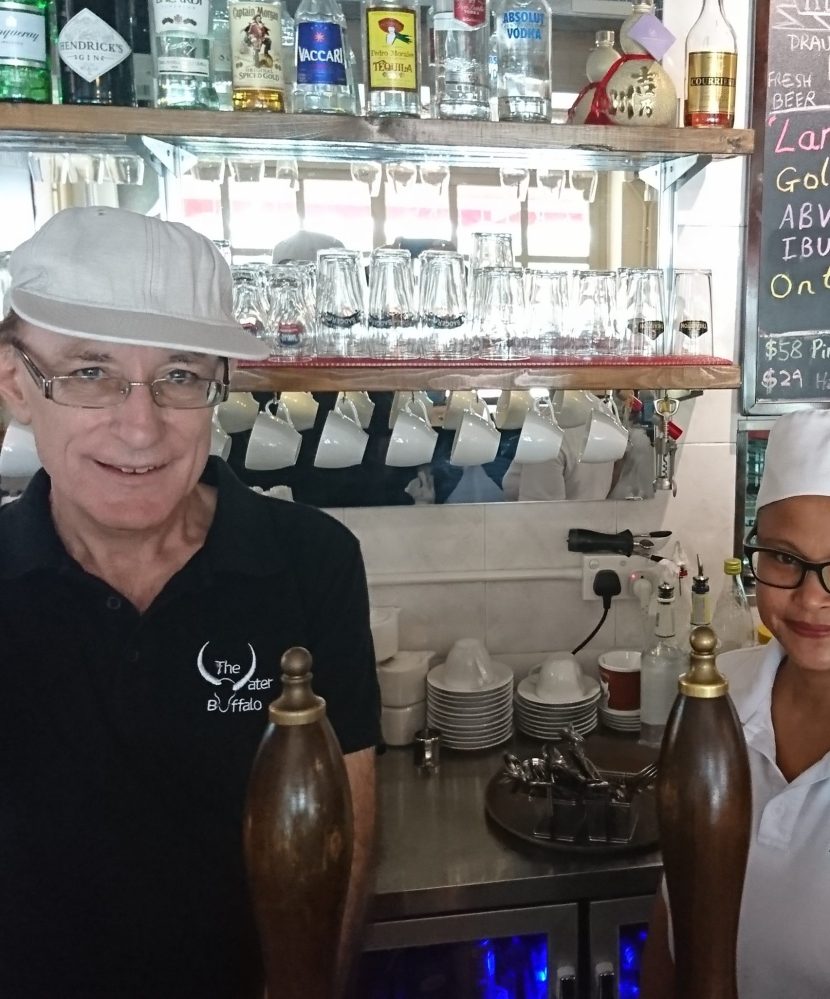
If you’re a fan of Lantau-themed products, here’s a new one – Lantau Peak, a craft beer now on tap at The Water Buffalo.
A pale ale brewed by proprietor Chris Riley and launched just last week, it lines up next to a range of arrestingly-named indie brews like Badger’s Hopping Hare, Old Peculier and Brains Black.
Chris, who opened the Pui O gastropub with his wife Jenny in April last year, knows his way around vats and hops.
He is a long-time home brewer, was twice runner-up in UK home brew competitions and has a PhD in chemistry
He admits it was initially “a bit scary” to move up from home brew to commercial production, but says it actually turned out to be easier.
The industrial equipment is much better at dealing with the tricky elements like cleanliness and temperature control, he explains.
“At home it’s very easy to get contaminated. Here I can pump hot water and cleaning agent through the equipment so it’s clean and sanitised.”
Lantau Peak is not Lantau’s first craft beer. Pilot Pierre Cadoret was the pioneer with Typhoon Beer, which he made in Mui Wo from 2009 until the venture was forced out by high rent.
Chris describes Pierre as a mentor. “I wouldn’t have been able to do this without him,” he said.
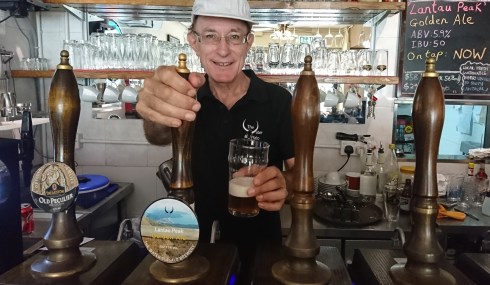
Brewmaster Chris Riley
He says that while Hong Kong has an emerging craft brew scene, he has to source the key ingredients, like roasted barleys and black and chocolate malts, from the UK and Australia.
As well as being one of only five Hong Kong micro-brewery pubs, The Water Buffalo is one of the few restaurants in the city, and the only one in Lantau, to offer gluten-free food.
Chris says when he went through a period of gluten-intolerance his wife Jenny, his partner in running the pub, worked up a portfolio of gluten-free dishes that they now serve patrons.
It a big deal for some people. There’s even a gluten-free beer, Daura Damm, from Spain.
“We have a good local following, but people will travel long distances if they know they can get a gluten-free meal,” Chris says.
Police investigate after two vehicles set alight in four minutes
Lantau police are investigating two nearly identical vehicle fires in the space of four minutes in South Lantau early today.
In each case a Toyota seven-seater vehicle was reversed into the front gate of a home and then set alight.
The first took place in San Wai, Pui O, at the front gate of a three-storey home at 2:49am, according to the Oriental Daily.

Apple Daily photo of the Pui O vehicle
The second was at No. 16 Shui Hau at 2:53am, where a vehicle reverse crashed into the gate and then drove forward into a fire hydrant before the occupants fled.
Fire Department officers said both cases were arson and called in the police.
The Shui Hau owner said he did not know why his gate was rammed. Police are viewing his security camera footage.
Police haven’t confirmed whether the two incidents are linked.
Photo (top): Burned out Shui Hau car (Oriental Daily)

Palm oil spill: beaches reopen but questions remain
Two weeks after a maritime collision caused a massive palm oil spill, the impact is receding and some of the oil is to be recycled, but key questions remain.
The circumstances surrounding the accident are not clear. It has not been explained why Guangdong officials took two days to notify Hong Kong about the spill on the city’s boundary.
It is also not known how much material remains in the water and the longer-term impact on marine life and coastlines.
The government, which is yet to confirm the exact location of the event, denies misleading the public by claiming it occurred in the Pearl River Estuary. Technically the site of the collision, 12 kilometres south of Lantau, is part of the estuary, but the description suggests the Pearl River to Lantau’s west or north-west.
What we know about the location is through Roy Tam, the head of environmental group Green Sense, who says he learnt from the Marine Department that the collision took place just south of Dazhizhou island, four kilometres from the Hong Kong maritime boundary.

The site of the collision, 12km south of Lantau (Source: Green Sense)
Green Sense has posted a video showing the route of the Panama-registered tanker, Global Apollon, on the morning of August 3. It was carrying 9000 tonnes of palm oil from Indonesia when it collided with Singapore-registered container ship Kota Ganteng.
The 10,700-tonne vessel is still anchored off Guishan, just west of Dazhizhou, according to shipping website maritimetraffic.com.
Tam and other activists have criticised Guangdong authorities about the delay in informing the Hong Kong government and urged them to improve their incident reporting systems, Apple Daily reports.
The Marine Department has said it is consulting with the Justice Department over legal action against the shipowners.
In another development, the Environment Protection Department is reported to have struck a deal with two companies to recycle some of the 207 tonnes of palm oil stearin collected on local beaches. But an EPD official admitted to SCMP.com:
…only some of the palm oil collected would be suitable for recycling. Some of it had been contaminated and would inevitably end up in a landfill.
The Leisure and Cultural Services Department reopened Pui O Beach on Tuesday afternoon. All Lantau beaches affected by the spill are now open to the public, although five Hong Kong beaches remain closed.
With the worst of the immediate impact over, the longer-term impacts need to be monitored. The government says its testing shows that the oil content of water “remains at a low level.”
But it is not clear how much oil remains in the water and how it will impact on the marine environment. In sufficiently large volumes palm oil has the ability to soak up bacteria, infecting all levels of the food chain.
Photo (top): Global Apollon (Source: maritimetraffic.com)
UPDATE: Govt under scrutiny over oil spill location and beach hazards
(UPDATING EARLIER STORY) The government handling of the palm oil spill is under scrutiny on multiple fronts with the revelation that it took place just 4km from local waters and amid claims that it is downplaying the health risks.
Roy Tam from environmental group Green Sense says he’s been told by the Marine Department the collision on August 3 took place only 5.7 kilometres away from the Soko Islands, just off Lantau’s southern coast, and only four kilometres from local waters.
But the government has described the incident as taking place in the Pearl River Estuary, which does cover waters south of Lantau, but the phrase suggests it was some distance from the city and most likely west or northwest of Lantau Tam told told Hong Kong Free Press:
“I don’t understand why the Hong Kong government did not use a more familiar name to refer to the location of the crash. When they say ‘Pearl River estuary,’ the inference is that it is far away from Hong Kong. However, the collision happened only four kilometres from us… ”
The government has also begun reopening beaches, including three on Lantau, but has been accused of ignoring the health hazards posed by the palm oil debris. The Food and Environmental Hygiene Department believes Hong Kong beaches could be hit by as much as 700 tonnes of palm oil next week, depending on currents.
Robert Lockyer, a marine environmental campaigner who has organised cleanup operations on Lamma, warns that while palm oil is safe in small quantities, in large volumes it functions “like a huge petri dish for bacteria.”
He urges the public to stay away from all beaches until the spill has been completely cleaned. Several volunteers who had helped collected oil debris on Lamma over the weekend had become ill, reporting vomiting, diarrhoea and nausea, he said.
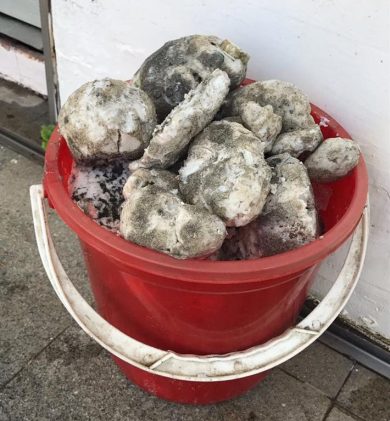
Collected from Pui O Beach on Saturday(Photo: Daphne Chu)
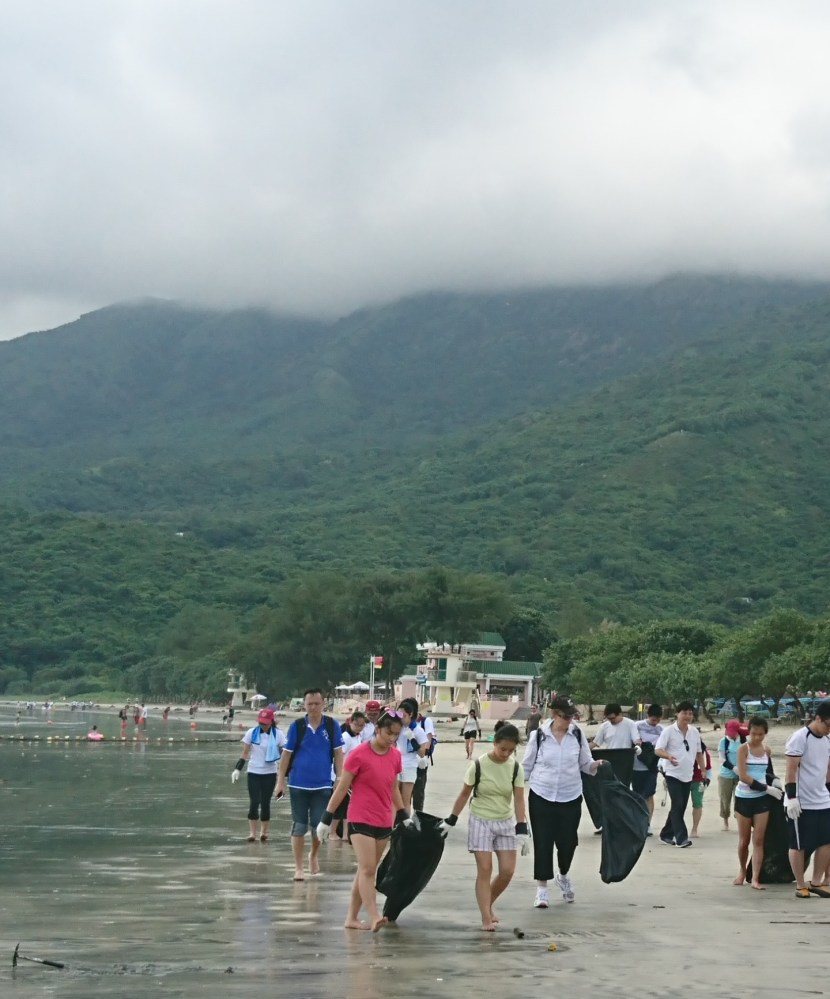
Lamma beaches and Pui O Beach on Lantau remain closed, but last Saturday the government announced Upper Cheung Sha, Lower Cheung Sha and Tong Fuk beaches had reopened to the public. Volunteer cleaning operations took place at Pui O as well as Lamma on the weekend.
Lockyer said local people were collecting the material and taking it home for candles or soap-making, believing it to be safe. One woman even said she would use it to cook food for pets. “We need to get the information out that this is not cool to be taking home.”
A press release issued on behalf of Lockyer and the volunteers states:
The palm oil coats plastic trash and the plastic trash floats ashore, collecting marine bacteria and micro-organisms as it lands on the beach or in the sand and decays. Clumps of palm stearin absorb micro-plastics, marine debris and chemicals dumped into the sea.
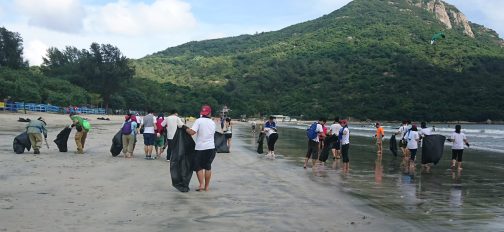
Volunteers collect palm oil on Pui Beach
A spokesperson for the Environmental Protection Department said it would continue monitoring the situation. “It has been safe so far,” she added.
The department said today it had found a “significant improvement” in the level of oil in the water but urged swimmers to “not to play with or take in palm stearin, and to rinse their feet before entering changing rooms.”
It said it would work with other departments in monitoring the spill helping the cleanup, “with a view to reopening the remaining beaches concerned as soon as possible.”
 Lantau Confidential