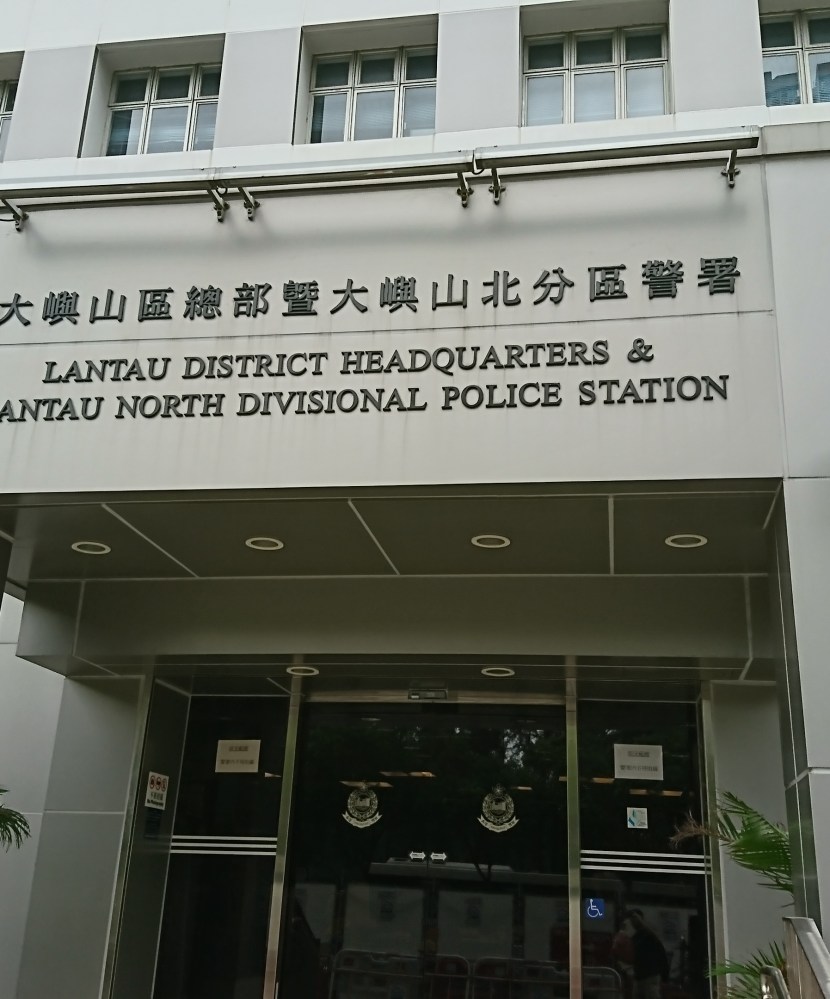
Police raided an illegal gambling den in Tung Chung and arrested 12 people yesterday, including an 83-year-old woman suspected of running the operation.
Police officers raided a village house in Ma Wan Chung at midday and seized 30 mah jong tables, including ten power-driven tables, and HK$1,600 in cash.
They arrested seven men and five women aged 53 to 83 on charges of gambling in a gambling establishment, Metro Radio Newsreports.
Among those arrested was an 83-year-old woman suspected of operating a gambling establishment.
The brawls, involving 13 prisoners and an unspecified number of staff, took place first in the laundry workshop and later in a dining hall on February 5.
Prison officers had received intelligence in late January about planned illegal activities and were on alert for the violence, the CSD said.
One prison officer suffered injuries to his shoulder and wrist and a prisoner sustained head and hand injuries in the brawls.
Both were transferred to hospital for further treatment.
Twelves prisoners involved in the brawls and suspected of involvement in illegal activity were separated and put under investigation.
The prison atmosphere was “stable” following the incidents, which had been reported to the police for further inquiry, CSD said.
The government has abandoned a plan to extend the Ngong Ping cable car to Tai O, but is now considering a water taxi service between Tai O and Tung Chung.
In an interview with Sing Tao Daily, Robin Lee, director of the Sustainable Lantau Office, said improving the capacity of Lantau’s tranasport network was one of its priorities.
He says the government has dropped the proposal to extend Ngong Ping 360 down to Tai O, acknowledging the strength of public opposition as well as financial issues.
However, Lee said the newly-established SLO, a bureau within the Civil Engineering and Development Department, hopes to improve Tai O’s external transport links with a water taxi service to Tung Chung.
The vessels would have a high carrying capacity and a flat bottom, seen in cities such as Paris and Bangkok, to enable them to pick up passengers from Tung Chung and enter Tai O River.
Currently the Fortune Ferry service operates between Tai O, Tung Chung and Tuen Mun. It runs to Tai O just four times a day on weekdays and a dozen times on Saturday and Sunday.
Lee said he was in discussions with the Transport Department to see if the frequency could be increased.
“In the past the concern has been that if the passenger volumes are too unpredictable, it will be difficult to find a company that will operate it on a long-term basis,” he told Sing Tao. He would shortly meet with the industry to discuss how to make the service viable.
Lee promised that “unlike the planning strategies of the past,” Lantau transport infrastructure would be developed in a way that avoided disturbing traditional lifestyles and the natural environment.
Hong Kong rural leaders are calling for incentives to encourage villagers to install solar equipment on their rooftops.
Junius Ho, a Legco member and Tuen Mun village chief, has called on the government to provide tax concessions and an easing on village housing restrictions.
The Heung Yee Kuk, the peak body of rural committees, has also begun a campaign for solar energy concessions, scmp.com reports.
Ho, whose New Territories West constituency covers Lantau, told scmp.com that rooftops of small houses were “ideal” for solar panels.
He says the the government should offer incentives to villagers, “like land rent or property rates waivers” as well as exemption from rooftop building regulations that might be regarded as illegal structures.
For example, it is currently illegal to place anything on the roof of the stair-housing, which is a natural site for a solar system.
Ho and the kuk are arguing that the expanded use of solar power can help the city reach its carbon emission target.
At present, Hong Kong gets 48% of its energy from coal, 27% from natural gas and the remaining 25 per cent from a combination of nuclear and renewables. The aim is to cut carbon emissions from 6.2 tonnes per capita in 2014 to below 4.5 tonnes by 2020 and eventually to as low as 3.3 tonnes, according to scmp.com.
Hong Kong lags behind its neighbours in its use of solar energy, which is widely deployed across China, Singapore, South Korea and Australia.
But one expert warns of a political backlash if the government gives preferential treatment just to indigenous villagers.
“It could be politically sensitive,” said Daphne Mah, director of the Asian Energy Studies Centre at Baptist University.
“Some non-indigenous villagers may think it is a double benefit because the indigenous villagers have already been allowed free land to build a house of their own.”
WWF HK last year ran a pilot project in Tai O (above) to show that 25 sq metres of solar panels could supply half of the power required by a four-member household. The system cost HK$87,500.
The group believes solar energy can meet more than 10% of the city’s energy needs.
Islands District vice-chairman Randy Yu backed the trial and also called for government support.
“Incentives like capital subsidies and providing technical support for rooftop solar installations can drive installation capacity in small-scale housing estates in the Islands district and in rural areas.
The bodies of four finless porpoises have been found in the space of 36 hours across Hong Kong, including Lantau.
A stranded juvenile finless porpoise was found on the beach at Tai Long Wan in South Lantau yesterday. The 1.42-metre long female showed moderate body decay, Ocean Park Conservation Foundation (OPCF) said.
Two others were discovered near Sai Kung yesterday.
In the first case, a young adult 0.97 metres long was found at Ham Tin Bay Beach. It was severely decomposed and bore three wounds believed to have been caused by a propeller.
The other was an adult female found in the sea off Silverstrand Beach. It was 1.4 metres in length and severely decomposed.
On Sunday the body of another stranded finless porpoise was found floating near the Hong Kong University of Science and Technology pier.
It was 1.31 metres long and was moderately decomposed. It was transported back to Ocean Park.
But so far the MTR Corp and the Transport & Housing Bureau had given no indication of the progress and had not begun any public consultation.
“As I understand it, initial design, research and exploration take 18 to 24 months, followed by public consultation and detailed design,” he said, suggesting the government was at risk of falling behind its target of a 2020 start.
Tang, who represents Yat Tung North on the Islands District Council, said the lack of progress showed the government was “neglecting the livelihood of the people in the district and deserves to be condemned.”
In a written response, the Transport Bureau said it had received a proposal just last month from MTR Corp on possible development the Tung Chung East and West stations. But it could give no further details.
“The actual implementation of the project will depend on the subsequent detailed engineering, environmental and financial research findings, and the latest assessment of passenger demand and the adequacy of resources,” it said.
The government has not set a precise timetable for the Tung Chung West residential development, but has said the first people are likely to move in in the early 2020s.
Preliminary work on the project, which will provide 14,000 apartments near Shek Mun Kap and Lung Tseng Tau, is now underway, the CEDD said in a submission to the District Council in December.
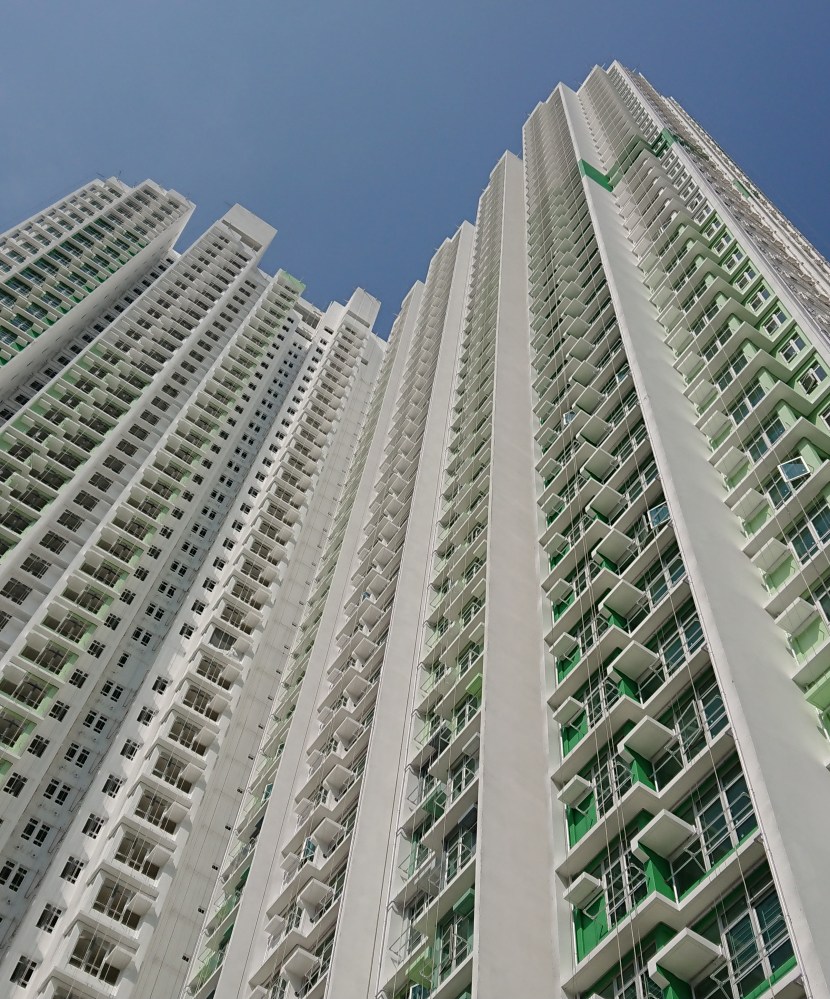
But work on Housing Authority apartments in Tung Chung area 39 , adjacent to the YMCA College, is nearly complete. It will provide 3,800 rental apartments that will hold an estimated population of more than 11,000.
Photo (top): Nearly-completed Housing Authority project at Tung Chung Area 39
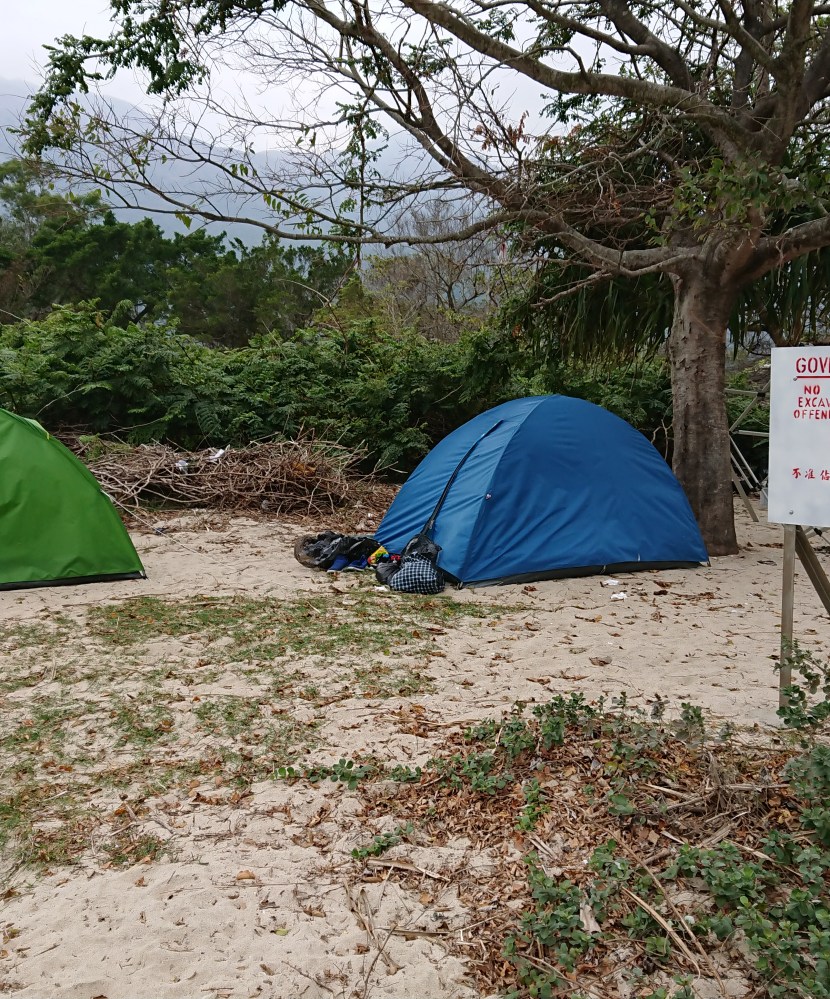
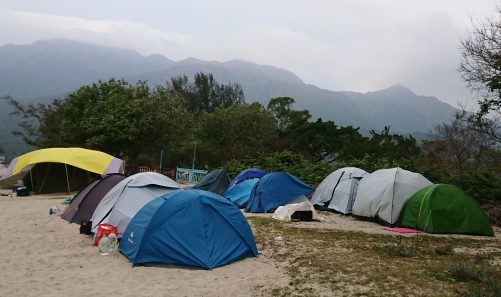
The Pui O camping ground, next to the wide sandy beach, has long been a popular retreat for local people.
Since the opening up of Hong Kong to mainland tourists it has become a magnet for mainland visitors and travel companies wanting to take advantage of its free accommodation.
Since then the LCSD has introduced a mandatory booking system for major holiday periods.
But still Pui O retains its appeal as a means to a cheap holiday in Hong Kong.
Some mainland travel groups are running tours promising ‘5-star camping’ at Pui O, with local media recounting tales of tourists lugging heavy suitcases full of shopping purchases around the campsite.
This weekend, an Apple Daily reporter visited Pui O and found a Shenzhen man, Mr Pan, who brought his family of “four or five” here for the holiday. He said he had saved thousands of yuan in hotel costs by camping.
A survey of Lantau residents and visitors has found that just half believe the level of consultation over government development plans for the island has been inadequate.
In addition, more than two-thirds were worried that the air quality of Tung Chung would deteriorate after the opening of the Hong Kong-Zhuhai-Macao Bridge.
The survey of 302 people in Tung Chung, Mui Wo, Pui O and Tai O was carried out by the Baptist University College of International Education last October. Just under half of the respondents were Lantau residents, 37% were tourists and 9% were local employees.
Half considered the level of government consultation inadequate or very inadequate, and only 8% considered it adequate.
They were also concerned about air pollution – 70% expect the opening of the HZM Bridge will make the air in North Lantau and Tung Chung worse – and the growing traffic loads in South Lantau, with 54% believing the volume of vehicles should be linked to the environmental carrying capacity.
Dr Karen Wu, a lecturer at the college, said the general public believed that development of Lantau should prioritise conservation of natural heritage and culture ahead of transport development. She said authorities should focus on protecting threatened conservation hotspots.
A Development Bureau spokesperson told the Economic Times that “as a whole, there is general public support” for the government’s Lantau plans.
Tom Yam, a Mui Wo resident and vocal critic of the ELM, points out that the government has consistently overlooked public opposition. He wrote in an scmp.com op-ed last August:
After last years’ public consultation on the future of Lantau, the government claimed general support for its development plan, ignoring the fact that more respondents opposed specifically the construction of the East Lantau Metropolis than supported it.
That survey had found that just 31% agreed on the creation of the ELM on artificial islands, with 56% opposing it.





 Lantau Confidential