
Category: Environment
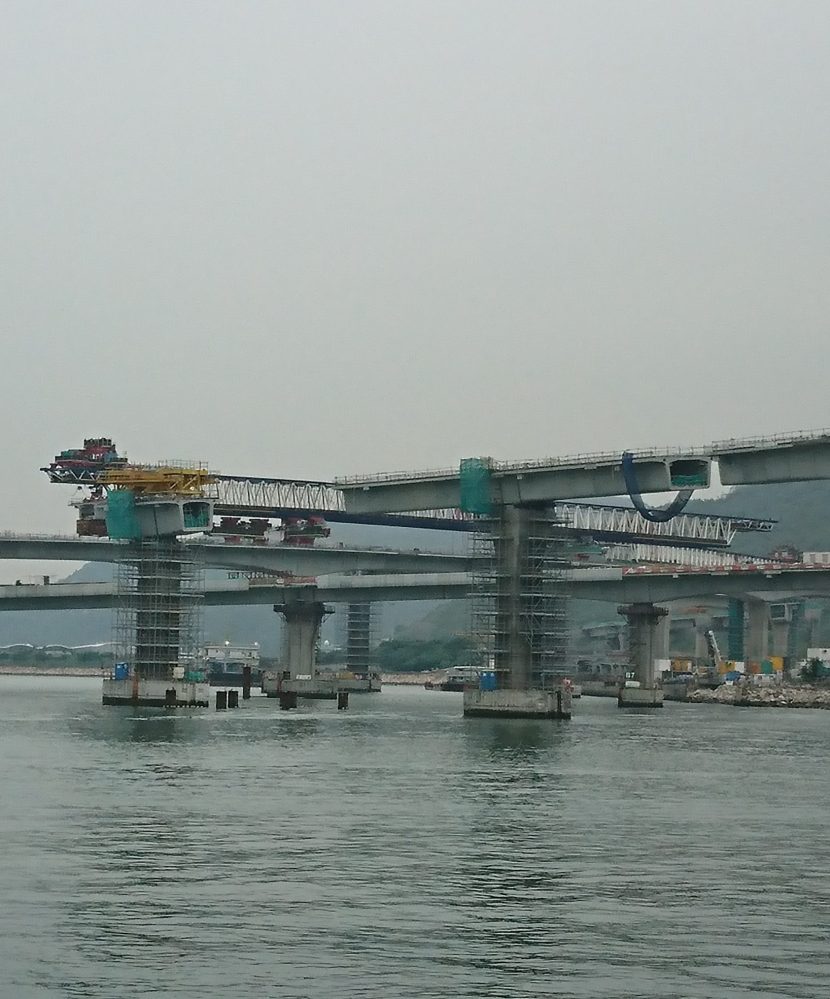
Tung Chung ozone worse, but PM2.5 has improved
The ozone level in Tung Chung has worsened in the last five years, but the presence of all other major pollutants has declined, according to government figures.
Air quality data released to Legco today show ozone levels increased 9% between 2013 and 2017, but level PM2.5 particulates fell 19% and sulphur dioxide is down 36% (see below).
Responding to a question from People Power member Raymond Chan, Environment Secretary Wong Kam-sing said the high ozone level was a result of “the influence of regional pollution.”
Chan said a number of Tung Chung residents had told him they felt local air quality had deteriorated in recent months and feared the opening of the Macau bridge would make the air even worse.
But Wong said apart from ozone, the level of air pollutants in Tung Chung was within government air quality targets.

Source: EPD
But he admitted that no assessment of the air quality impact of the HK-Macau bridge had been made since 2009. The 30-kilometre main bridge is due to open in May.
Wong said a Highways Department study prior to construction had concluded that “air quality at sensitive receivers in the vicinity” of the bridge would comply with government targets.
He said there was no plan to further review Tung Chung air or the effects of traffic crossing the new bridge.
But he said the EPD would continue to monitor the air quality across Hong Kong, including Tung Chung, and was also reviewing the current air quality objectives (AQOs).

Another dead porpoise found on a Lantau beach
Another finless porpoise has been found dead on a Lantau beach, taking the total to six deceased dolphins and porpoises since Chinese New Year.
Hong Kong Ocean Park Conservation Foundation says the decomposed body of a porpoise was discovered on Lower Cheung Sha Wan Beach on Saturday.
The porpoise, about 67 centimeters long, was taken to Ocean Park for further examination in order to understand the cause of death, Ming Pao reports.
The body of a stranded juvenile porpoise was discovered on Tai Long Wan Beach on February 20 – one of four deaths over the Lunar New Year.
Apart from one porpoise that was most likely struck by a marine propeller, most of the deaths appear to be a result of stranding.
Photo: Apple Daily/Ocean Park Conservation Foundation

Rural bosses seek solar incentives for villages
Hong Kong rural leaders are calling for incentives to encourage villagers to install solar equipment on their rooftops.
Junius Ho, a Legco member and Tuen Mun village chief, has called on the government to provide tax concessions and an easing on village housing restrictions.
The Heung Yee Kuk, the peak body of rural committees, has also begun a campaign for solar energy concessions, scmp.com reports.
Ho, whose New Territories West constituency covers Lantau, told scmp.com that rooftops of small houses were “ideal” for solar panels.
He says the the government should offer incentives to villagers, “like land rent or property rates waivers” as well as exemption from rooftop building regulations that might be regarded as illegal structures.
For example, it is currently illegal to place anything on the roof of the stair-housing, which is a natural site for a solar system.
Ho and the kuk are arguing that the expanded use of solar power can help the city reach its carbon emission target.
At present, Hong Kong gets 48% of its energy from coal, 27% from natural gas and the remaining 25 per cent from a combination of nuclear and renewables. The aim is to cut carbon emissions from 6.2 tonnes per capita in 2014 to below 4.5 tonnes by 2020 and eventually to as low as 3.3 tonnes, according to scmp.com.
Hong Kong lags behind its neighbours in its use of solar energy, which is widely deployed across China, Singapore, South Korea and Australia.
But one expert warns of a political backlash if the government gives preferential treatment just to indigenous villagers.
“It could be politically sensitive,” said Daphne Mah, director of the Asian Energy Studies Centre at Baptist University.
“Some non-indigenous villagers may think it is a double benefit because the indigenous villagers have already been allowed free land to build a house of their own.”
WWF HK last year ran a pilot project in Tai O (above) to show that 25 sq metres of solar panels could supply half of the power required by a four-member household. The system cost HK$87,500.
The group believes solar energy can meet more than 10% of the city’s energy needs.
Islands District vice-chairman Randy Yu backed the trial and also called for government support.
“Incentives like capital subsidies and providing technical support for rooftop solar installations can drive installation capacity in small-scale housing estates in the Islands district and in rural areas.
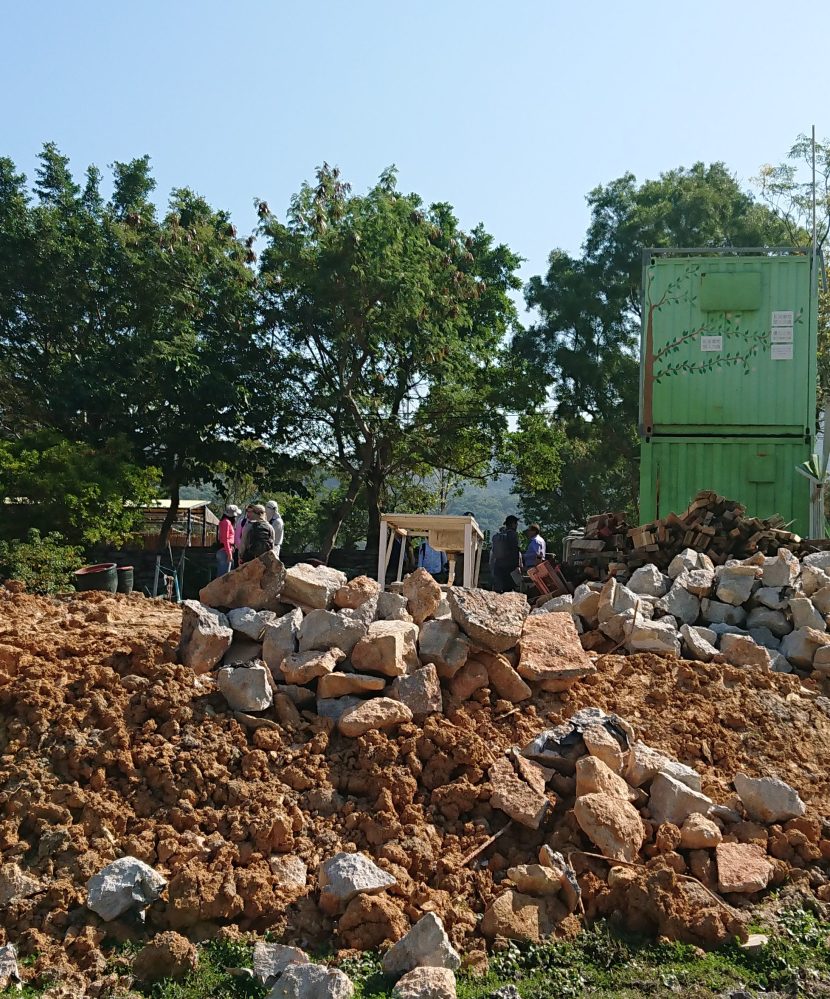
Lam won’t condemn wetland dumping or amend law to stop it
Chief Executive Carrie Lam has refused to condemn wetland dumping and has ruled out any changes to the law to preserve Lantau and other threatened areas.
Lam admitted in Legco yesterday that there were “loopholes in the law” but said that some “behaviour that looks like it is harming the ecology may not in fact be illegal.”
Lam’s comments, her first on the issue since protestors dumped waste on her doorstep on Sunday, were in response to a question from legislator Eddie Chu, who brandished a toilet seat found in a Pui O landfill.
Chu asked the CE if she would condemn those who “have exploited legal loopholes” to damage Coastal Protection Area land on South Lantau.
He also asked if she would amend the law to ensure its preservation.
Lam declined to answer, but acknowledged there was “room for improvement in monitoring and enforcement.”
She called for stronger public education “to protect our beautiful coastline and other rural areas.”
Lam’s responses fail to distinguish between fly-tipping, which is illegal, and landfilling, which has become government-authorised waste dumping in rural areas.
They also fly in the face of her own policy, which is to conserve South Lantau generally and Pui O wetland specifically.
In her October policy address Lam said Lantau would be conserved by the new Sustainable Lantau Office, based on the Sustainable Lantau Blueprint issued last June.
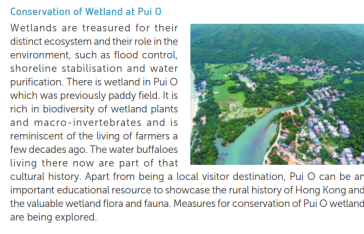
“Measures for conservation of Pui O wetland are being explored,” it states.
Yet when it comes to ensuring these “treasured” ecosystems can be preserved, Lam not only is unable to offer any “measures” – she cannot find fault with the steady destruction taking place.
It is clear the CE has no intention of taking on powerful rural interests to stop wetlands from disappearing under a mountain of construction waste.
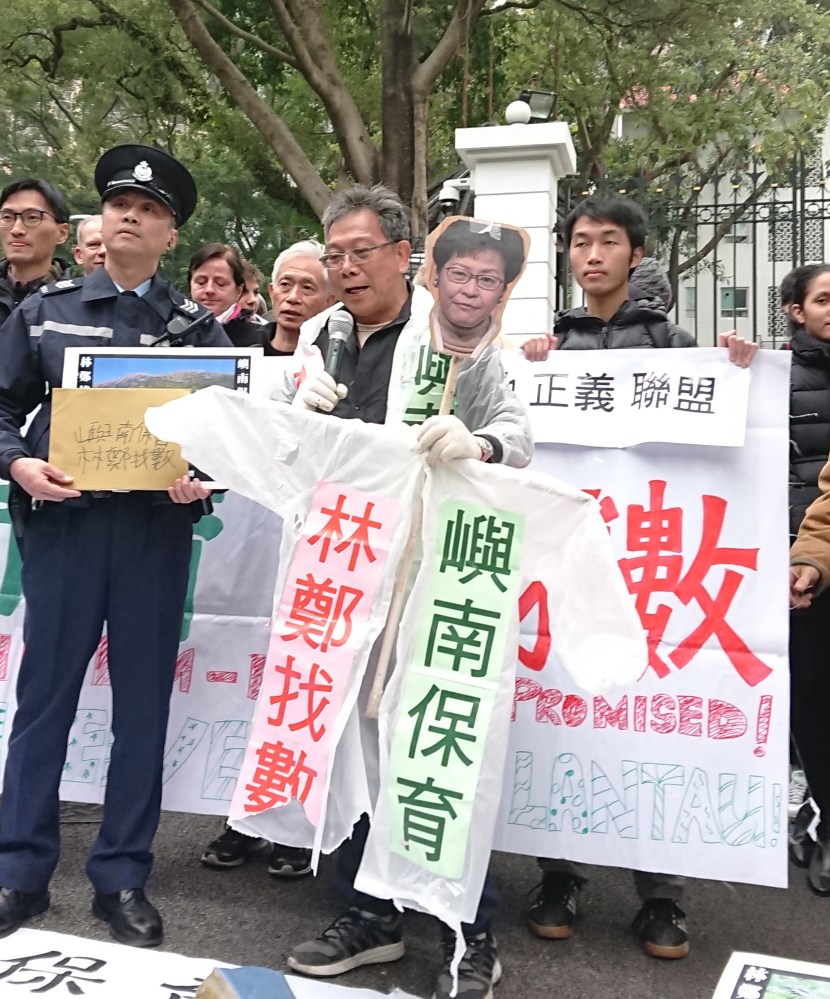
Protestors dump Lantau waste at Govt House, warn of further action
Demonstrators dumped construction waste outside Carrie Lam’s residence today to protest landfilling and wetland destruction, with Legco member Eddie Chu warning of further protests “if the government ignores us.”
The rally of about 30 people marched from Central ferry pier, bringing with them two trolleys filled with waste from South Lantau landfill sites.
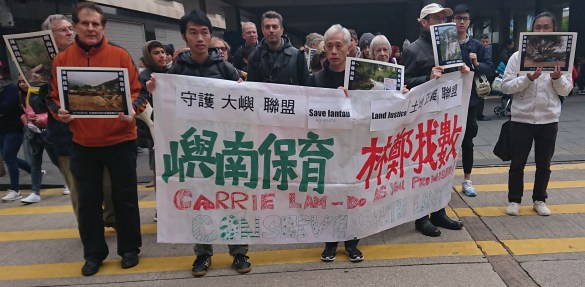
Occupying Central
They poured the trash onto the ground at the Government House gate to remind Lam that conserving South Lantau and protecting the wetlands are her own policies.
A police sergeant accepted a petition on behalf of Lam.
A police contingent almost as large as the protest itself watched over the event.

Police presence
Eddie Chu told the demonstrators:
“We will come back if the government does not take the right actions to deal with this dumping issue.
“This is only the first action. There will be actions following if the government ignores us.
“We will not allow this to happen in South Lantau. We are not going to allow it to happen anywhere in rural Hong Kong.”
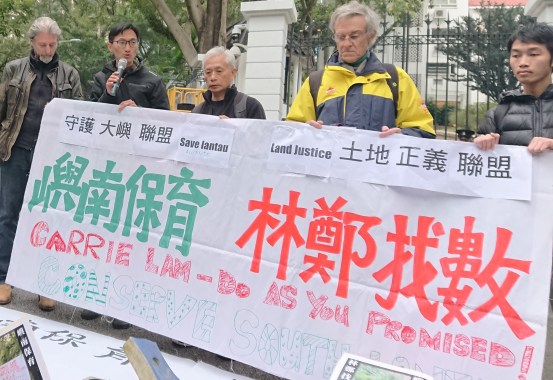
Paul Zimmerman (left), Eddie Chu (second from left)
Paul Zimmerman, head of Designing Hong Kong and a candidate for the architectural constitutency at the forthcoming by-election, said the government needed to introduce new legislation to protect rural Hong Kong.
“If you want development in Hong Kong you have to give confidence to people that conservation truly is conservation,” he said.
He said landfilling of the kind carried out in rural Hong Kong was “destruction on purpose, to create development value,” to ensure land was already destroyed so it could be rezoned.
But the symbolic waste dumping may come at a cost to the protestors. Organiser Eddie Tse, head of the Save Lantau Allianced said police had warned him he could be fined for dumping the waste.
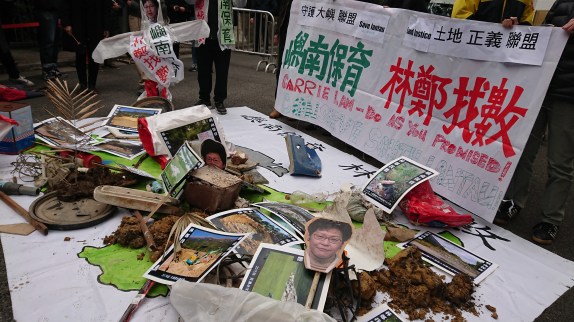
What a waste
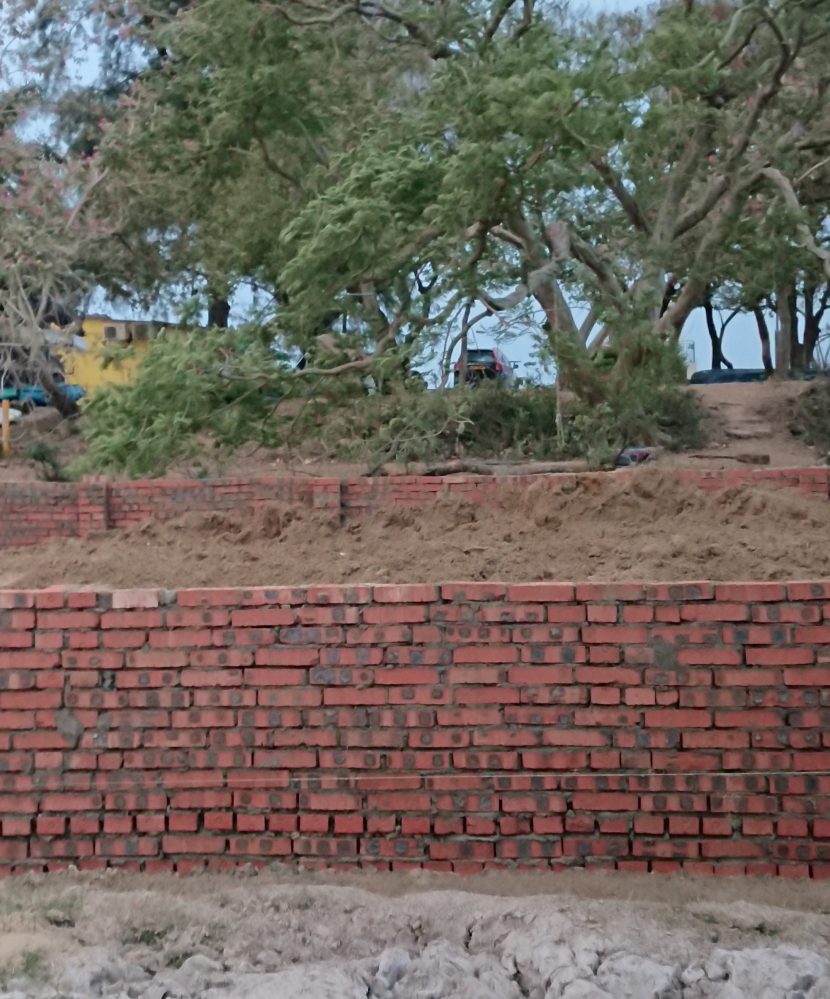
Rejected: TPB turns down application from Pui O ‘brick wall’ site
The Town Planning Board has rejected an application from Pui O’s controversial ‘brick wall’ wetland plot to convert the site into agricultural use.
The site owner, Ms Au-Yeung Kam Ping, had asked to convert the 411 sq metre site into a farmland plot covered with landfill 1.2m high.
But in a ruling Friday the TPB said Au-Yeung failed to provide sufficient information about the material used for landfill, could not justify the need for the 1.2m high landfill and was unable to demonstrate “no adverse impact on surrounding areas” (see full decision below).
The board said approval “would set an undesirable precedent” for similar applications within the Coastal Protection Area.

Failed to show ‘no adverse impact’
While this is a victory for local residents and environmental activists who have campaigned against the destruction of this wetland site, the TPB decision relates only to the application to turn the land-use into farmland. The board does not rule on environmental harm or on the legality of the landfill.
The owner, Au-Yeung, has courted local notoriety by building a brick wall around the site.
Additionally, Environmental Protection Department surveillance cameras caught trucks dumping landfill on the plot before the department had given permission to fill.
It is not clear who was responsible for the dumping, but activists are furious that the EPD still gave the go-ahead for the landfilling despite knowing that fly-tipping – a criminal offence – had taken place.
And despite the video evidence in its possession the EPD has been unwilling to use its powers to pursue and arrest the fly-tippers or to order a stop to the landfilling.
A Judicial Review decision on the EPD’s handling of these wetland landfill cases is pending, based on a similar case on a nearby Pui O site three years ago.
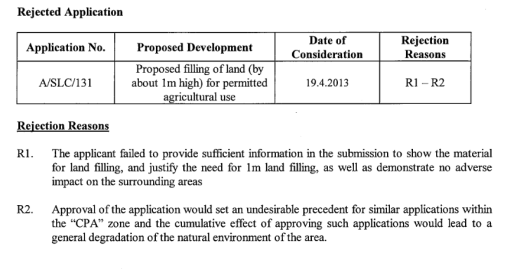
The TPB decision
EPD again unwilling to act as another wetland site is landfilled
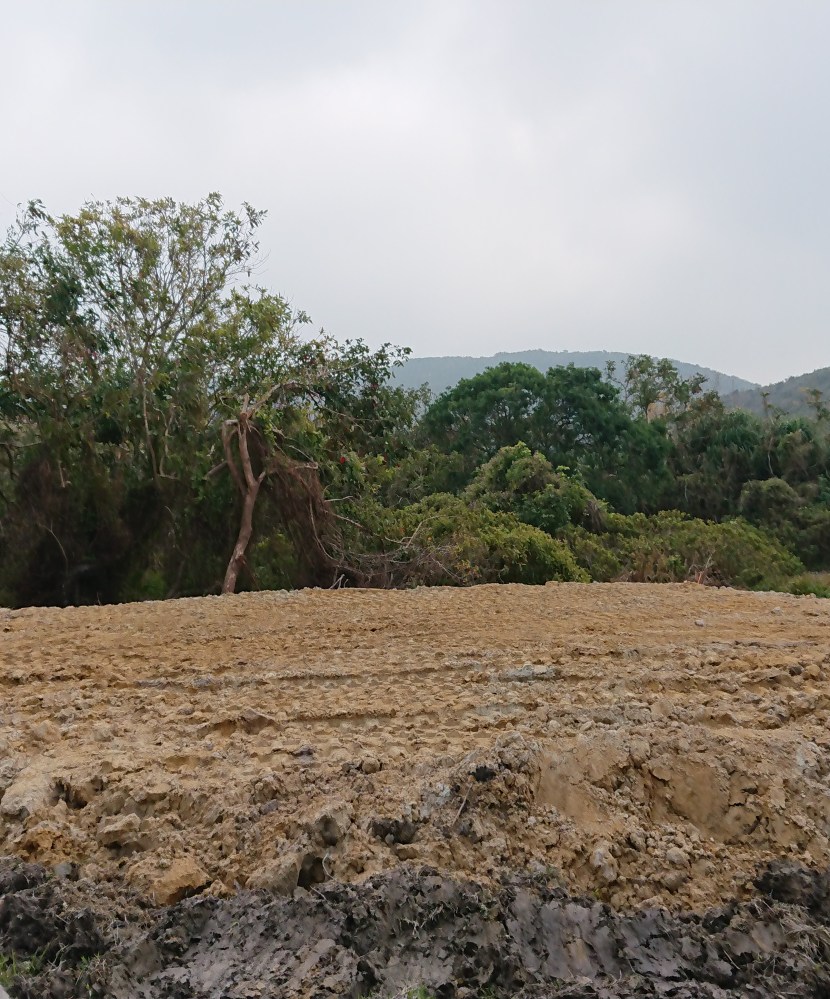
A Shui Hau site appears to have become the latest slice of South Lantau wetland to have been illegally landfilled.
Save Lantau Alliance convenor Eddie Tse discovered the landfilled site, about two-thirds between the village and the shore, a week ago.
The Coastal Protection Area (CPA) site is not approved for any development and has received no ‘acknowledgement’ for landfilling from the EPD.
In reply to inquiries, the Planning Department said that the TPB had not received any planning application for the site.
The Environmental Protection Department (EPD) said that it received two complaints over landfilling there earlier this month, Commercial Radio reported.
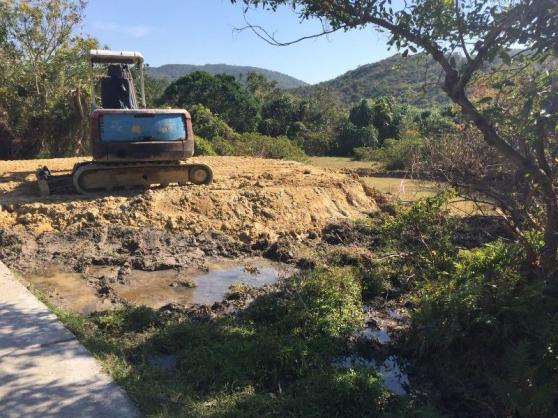
Landfill work last week (Credit: Save Lantau Alliance)
EPD officials have reportedly inspected the location and told Commercial Radio that if there is evidence of a breach of the Waste Disposal Ordinance (WDO), “the department will certainly take enforcement action.”
It has used the same language in the most recent Pui O case, which likewise appears to be a blatant breach of the WDO, a law that allows for waste dumping only with EPD approval.
Despite strong evidence, including video footage of dumping taking place prior to EPD ‘acknowledgement,’ the department has taken no action.
Its passivity flies in the face of the government’s own policies and aspirations. The Sustainable Lantau Blueprint has identified north Lantau as a focus of development and South Lantau for conservation.
Release of the latest South Lantau Outline Zoning Plan (OZP) last week also highlights the government’s inability to conform with its own policies.
The plan has allocated 162 ha in South Lantau for CPA land, which it says it is intended to
“conserve, protect and retain the natural coastlines and the sensitive coastal natural environment, with a minimum of built development. It is also intended to safeguard the beaches and their immediate hinterland, and to prevent haphazard ribbon development along the South Lantau Coast. A long strip of land between the coastline and South Lantau Road stretching from Pui O to Shui Hau and the sandy shore of the gazetted bathing beaches at Pui O, Cheung Sha and Tong Fuk are zoned CPA.”
Despite the name, the CPA carries no enforcement mechanism.
In this latest case the government has shown once again it is unwilling to use the enforcement tools that it has to hand.
Five Lantau beaches added to priority cleanup list
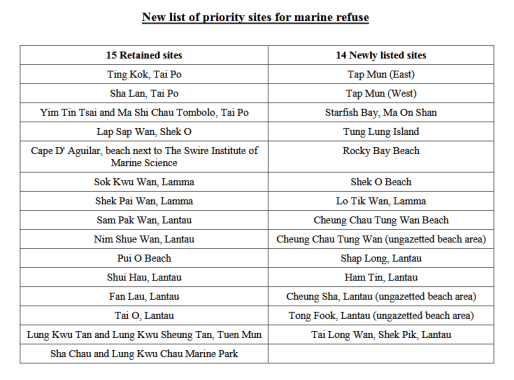
Five more South Lantau beaches to the government’s priority foreshore cleaning roster.
From now on Cheung Sha, Tong Fuk, Shap Long, Ham Tin and Tai Long Wan are among 29 beaches that will be serviced by Marine Department cleaners.
Pui O, Fan Lau and Tai O on Lantau’s south and western coast, and Sam Pak Wan and Nim Shue Wan near Discovery Bay, were already on the list.
The Environmental Protection Department updated the list of coastal sites based on “factors including cleanliness, the amount of refuse collected, cleaning frequency, geographical and hydrodynamic conditions, public accessibility, ecological value and concerns raised by the public,” a government statement said.
A dozen beaches were dropped list because of “sustained improvements in their cleanliness,” the statement said.
South Lantau residents organised multiple beach cleanup operations last year after two typhoons and a palm oil spill.
Cleanup operations on the priority beaches have increased 50% since the list was created two years ago, the government says.
It says Hong Kong is now working with 13 cities in the Pearl River catchment to monitor real-time rainfall data to help predict which beaches might be hit with heavy volumes of marine rubbish.
A notification system has been activated seven times.
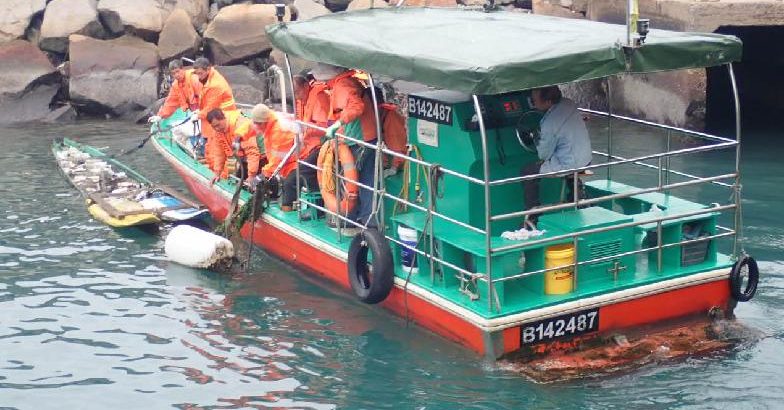
The Marine Department’s contractor has been operating 80 scavenging vessels to clean up floating refuse in Hong Kong waters since October.
The contractor’s fleet includes six new quick response workboats and two scavenging catamarans equipped with mechanical devices to increase the efficiency of clean-up operation in narrow water channels and to enhance scavenging service in offshore waters. In addition, the number of foreshore cleaning teams has been increased from two to three in order to step up efforts in cleaning up the foreshore areas.
Pui O wetland: EPD still can’t work out if law was broken
Nearly two months after recording unauthorised dumping on a wetland site, the Environmental Protection Department (EPD) says it is still not certain if any law has been broken.
In a letter to local residents today, an EPD staff said officials were investigating the case “and would take enforcement action if there is sufficient evidence of violation of the Waste Disposal Ordinance (WDO).”
Yet at a meeting at the Pui O site on December 29, EPD officials advised that the CCTV had caught unauthorised dumping on the site between November 20 and 23.
Under the WDO, owners of Coastal Protection Area sites like this one must apply for an ‘acknowlegement’ from the EPD if they wish to carry out landfilling.
Local activists point out that dumping before receiving ‘acknowledgement’ from the EPD is a clear breach of the law.
They also say the EPD should have stayed the application pending the outcome of a judicial review into the department’s handling of dumping and landfilling, also at a Pui O site.
Additionally, the landowner has applied to the Town Planning Board to change the use to ‘agricultural’, yet has since built a brick wall around the site.
Paul Zimmerman, CEO of Designing Hong Kong, said the problem is that EPD is “limiting itself to the WDO rather than protecting land reserved for conservation purposes.”
The landfilling, and the inability of the EPD to stop it, flies in the face of the government’s own policy.
Chief Executive Carrie Lam referred to the importance of the Pui O wetland in her September policy address. The wetland, an important buffalo habitat, is also designated for protection under the Sustainable Lantau Blueprint.
The Sustainable Lantau Office met with other departments, including the EPD, the Planning Department and the police, last week work up a plan to stop trucks dumping construction waste on Pui O.
But that seems too little too late, and addresses only one of many reasons for Pui O’s disappearing wetland.
The years of lax enforcement by the EPD means landowners see no impediment to turning their wetland sites into other more profitable uses. Precedent is on their side.
The only option is a long-term solution. A land-swap, given the large number of owners, would take years, decades even.
The only solution is for the government to buy the wetland plots.
Aquisition of the wetland to protect the habitat, the buffalo and the local tourist economy would cost millions, but it is just a snip compared to the tens of billions taxpayers have laid out for cost overruns on dubious public works.
It would also demonstrate – to itself and the public – that the government believes in its own policies.
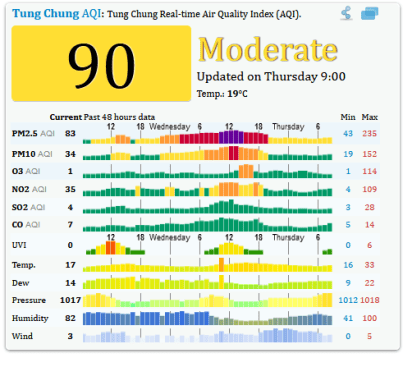
Tung Chung facing more hazardous air over weekend
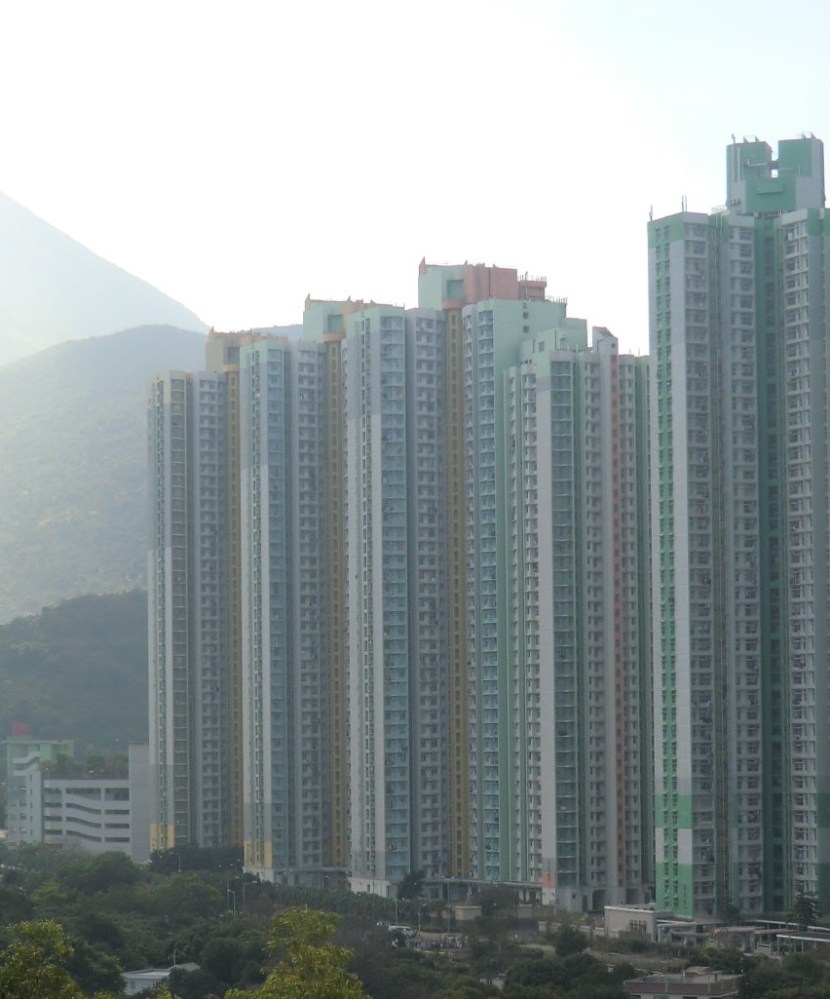
After pollution readings reached dangerous levels yesterday, Tung Chung is facing further hazardous air over the weekend – unless rain can clear the skies.
Readings from both the World Air Quality Index, also known as AQICN, and the Hong Kong government Air Quality Health Index (AQHI) hit hazardous levels yesterday.
Tung Chung recorded on the AQICN chart of ‘very unhealthy’ for four hours, which it describes as ‘emergency conditions’ in which all people are urged to stay indoors.
The AQHI showed Tung Chung reaching the ‘serious’ level, for six hours up to 7pm yesterday evening – one of six locations around Hong Kong to do so.
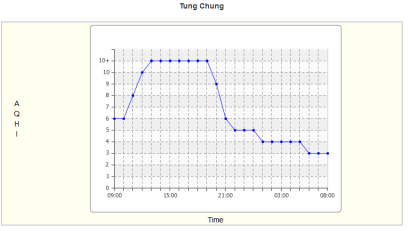
Tung Chung air, Wednesday (AQHI)
AQICN says that while today is likely to be merely ‘unhealthy for sensitive groups,’ it predicts extended periods of ‘unhealthy or very unhealthy’ over the weekend and Monday.
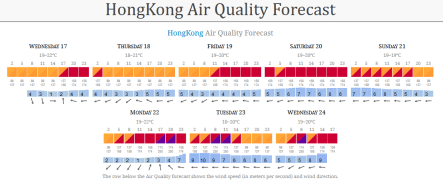
More bad air (AQICN)
The AQHI forecast is for “low to very high” risk today.
In a statement issued 11am yesterday EPD called on children and elderly to stay indoors and for the general public to avoid strenuous outdoor activity:
Higher than normal levels of nitrogen dioxide and particulates have been recorded in the territory since early this morning. Hong Kong is being affected by an airstream with higher background pollutant concentrations. In addition, light wind hinders effective dispersion of air pollutants. Sunshine enhances photochemical smog activity and the formation of ozone and fine particulates, resulting in today’s high pollution in the vicinity of Hong Kong. The high level of ozone has promoted the formation of nitrogen dioxide, particularly in parts of the urban areas and at the roadside.
However, it noted that the pollution levels could ease with the rain patches predicted for Friday.
At 9:30am Tung Chung air was rated moderate on the AQICN index.
 Earlier this week the EPD released data that showed the number of unhealthy air days last year had nearly doubled over 2016. The department attributed this to warmer weather and lower cloud cover, making it easier for ozone.
 Lantau Confidential