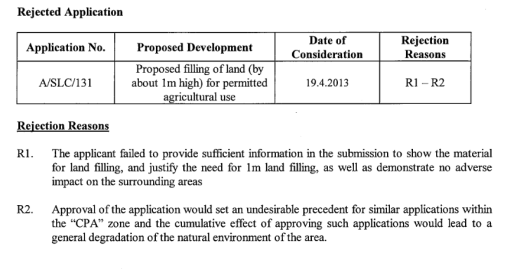
But in a ruling Friday the TPB said Au-Yeung failed to provide sufficient information about the material used for landfill, could not justify the need for the 1.2m high landfill and was unable to demonstrate “no adverse impact on surrounding areas” (see full decision below).
The board said approval “would set an undesirable precedent” for similar applications within the Coastal Protection Area.
Failed to show ‘no adverse impact’
While this is a victory for local residents and environmental activists who have campaigned against the destruction of this wetland site, the TPB decision relates only to the application to turn the land-use into farmland. The board does not rule on environmental harm or on the legality of the landfill.
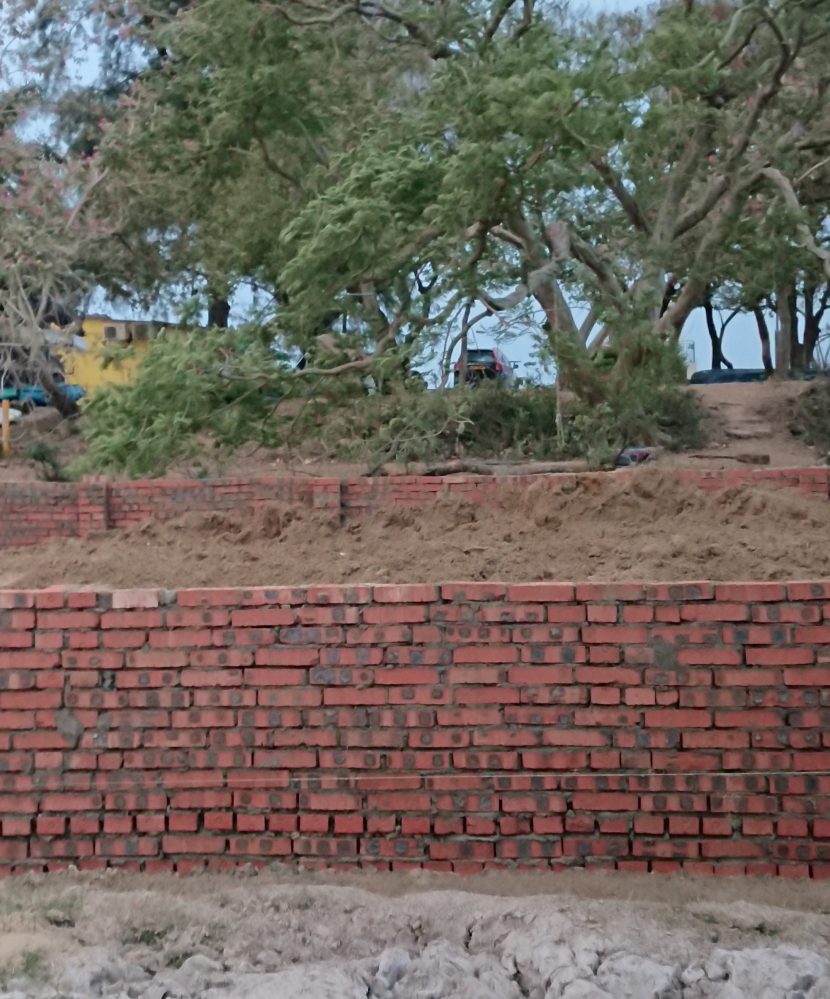
The owner, Au-Yeung, has courted local notoriety by building a brick wall around the site.
Additionally, Environmental Protection Department surveillance cameras caught trucks dumping landfill on the plot before the department had given permission to fill.
It is not clear who was responsible for the dumping, but activists are furious that the EPD still gave the go-ahead for the landfilling despite knowing that fly-tipping – a criminal offence – had taken place.
And despite the video evidence in its possession the EPD has been unwilling to use its powers to pursue and arrest the fly-tippers or to order a stop to the landfilling.
A Judicial Review decision on the EPD’s handling of these wetland landfill cases is pending, based on a similar case on a nearby Pui O site three years ago.
Ngong Ping cable car numbers fell again last year, apparently due to the continuing decline in mainland visitors.
In annual figures published yesterday Ngong Ping 360, a division of MTR Corp, said the average daily number of passengers declined 3.2% last year to 5,254.
With the cable car out of operation for maintenance for five months, the total number of visitors, 1.04 million, was well down on the 2016 level of 1.71 million.
Ngong Ping 360 visitor numbers peaked at 1.83 million in 2014 and have fallen in two of the three years since.
In that time the proportion of non-Chinese tourists has increased from 51% to 57%, while the China share has declined from 31% to 27%.
Ngong Ping 360 says its reaping the of its greater focus on southeast Asian nations, the number of Philippines and Indonesian guests up 56% and 53% respectively.
The total number of visitors to Hong Kong last year declined 4.5% to 56.65 million, with the mainland total down 6.7%.
To boost growth, Ngong Ping 360 plans to launch a “virtual reality and multi-media sensory attraction” series next month, called VR360.
“In those days, anybody could come to Hong Kong and get a job. No questions asked, cash in hand,” she says of her early days.
There were plenty of gweilo jobs in English teaching, bars and on filmsets, she says, adding a few pointed remarks about ‘begpackers’.
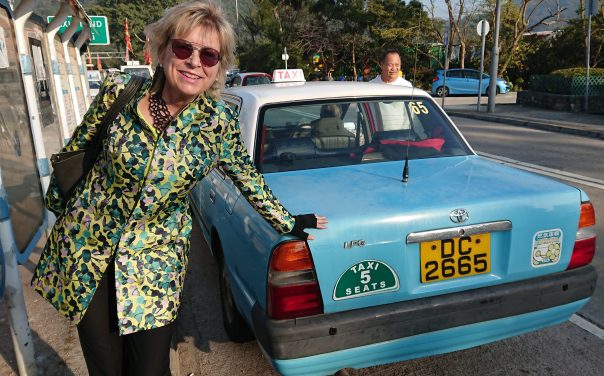
Cecilie spent several weeks in a cramped unit with seven others in Chungking Mansions before fleeing to Mui Wo.
“I had to take all my possessions into the shower. I was tired of them being wet all the time,” she said.
Her first home was in Pak Ngan Heung, which she shared with two others. She later lived in Tai Tei Tong for ten years before moving to Pui O 15 years ago.
For many years she was an English teacher on Hong Kong Island, schlepping the 75-minute daily ferry commute via Peng Chau.
Her biggest group of students was Japanese housewives. “When the bubble burst in Japan most of them left.”
In the meantime Cecilie, who already spoke and read Mandarin, had taught herself the local language.
She never studied it formally, but picked it up “just talking to people” – people like her Chinese poker partners on the long ferry commute.
Friends began pestering her to teach Cantonese, and that is what she has been doing, in her own unique style, for the last two decades.
She took students to bars and wet markets and on Shenzhen shopping trips, forcing them to apply their Cantonese in realistic situations.
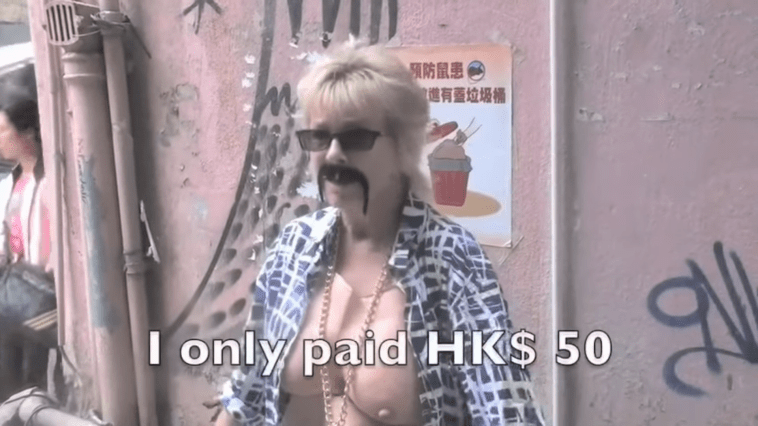
She also created a body of memorable YouTube videos, featuring her moustachioed alter ego, strap-on breasts and banjo, and an RTHK show and podcast called Naked Cantonese.
It has made her a defender of Cantonese language and culture at a time when they are under constant attack.
“I really like Cantonese – it is so funny. Mandarin is now a communist language for me, but Cantonese is a funny language, a beer and joke language,” she said in an interview last year with Apple Daily.
People often approach her in public or write to her or to express support – although one of her vexations is that few of them do so in Chinese. “They know I can speak and write it but there’s just NO way I can understand and read it!”
A bigger vexation, and the chief factor in her departure, is the “uglification” of the city under its Beijing landlords.
“The uglification of Hong Kong and destruction of Lantau is the main reason. I can’t live among skyscrapers, concrete and fencing anymore.”
“It’s such a metaphor,” she says. “People have to be corralled. I am sure the metreage has doubled in the last five years. That’s my observation as I walk everywhere.”
She points to the 300m-long fence at the side of South Lantau Road down to the Mui Wo roundabout.
“I think we have more accidents here because people get trapped on the road.”
She reflects on how Lantau has changed over the years.
“If you think it is out of the way today, it was way off the track then,” she said.
In those pre-airport, pre-MTR days, “there was no fast ferry, no Tsingma Bridge” – just the plodding ferry.
Mui Wo had three bars – the China Bear was called Fixed Crossing- and “it was much more crazy than now. There were lots of singles in 20s and 30s. Now it’s middle-aged and families.”
Cecilie says Lantau appealed because it was an island – as is her new home, Majorca, where she will be working as a writer and cartoonist for a Norwegian firm.
“It’s my dream job.”
When Cecilie flies out she takes with her not just irreverent Cantonese schtick, and not just a bridge between east and west, but yet another slice of the city’s spirit.
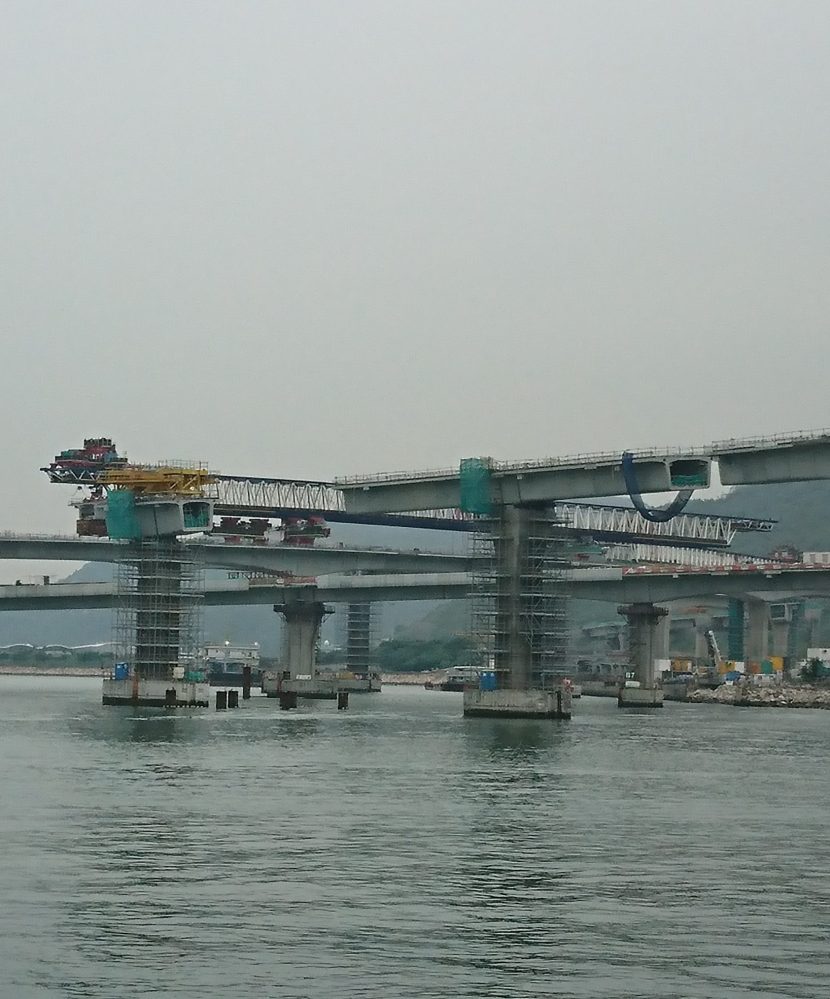
The government is considering the construction of car parks for both visitors’ and local residents’ vehicles at the HK-Macau bridge border, Transport and Housing Secretary Frank Chan said yesterday.
He told Legco that under the current design the Hong Kong crossing, next to Chek Lap Kok Airport, has no inbound car park, although it has 650 spaces for local private cars.
By comparison, Macau has created 3,800 parking spaces for visitors’ private cars.
Chan said the CEDD and Planning Department were now conducting a feasibility study on how to optimise the land around the border crossing.
He said depending on outcome of the study, the government would “consider providing parking spaces (including the feasibility of inbound car park)” to meet the needs of both Hong Kong residents and visitors.
The Guangdong and Hong Kong governments announced last month that the quota for Hong Kong cross-boundary private cars across the HZMB will increase from 3,000 to 10 000.
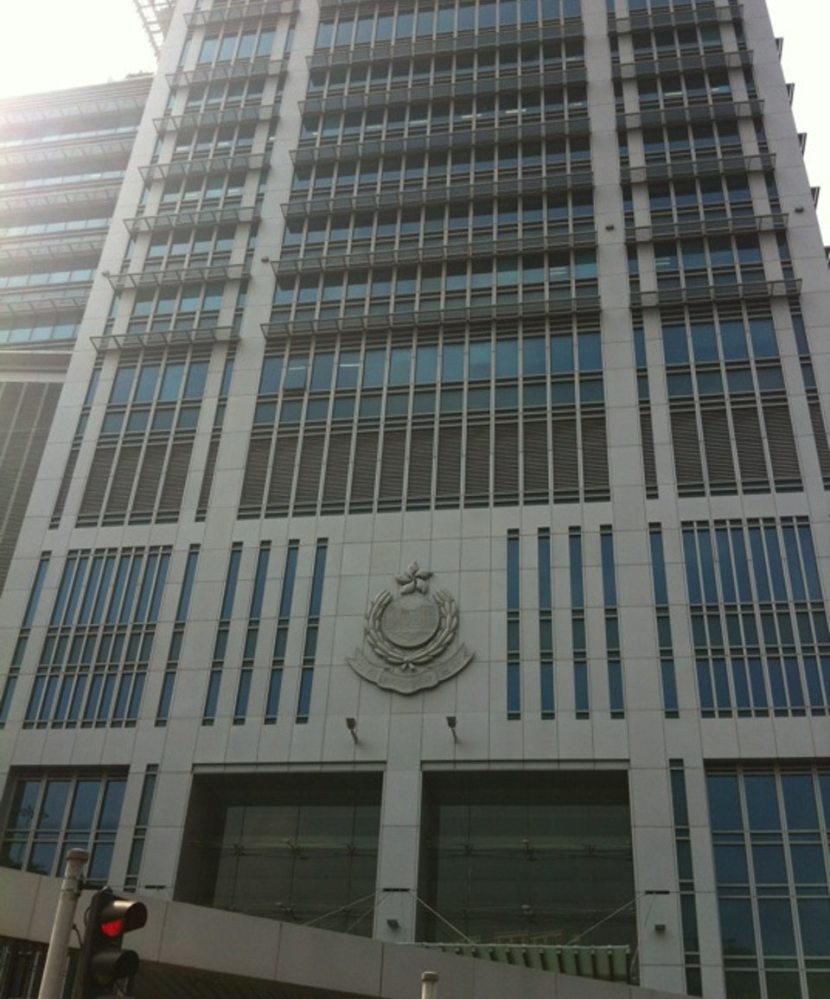
Four men have been charged with criminal damage over an attack on a private car in Mui Wo on Sunday evening.
Anti-triad squad detectives are investigating the incident on Ngan Kwon Wan Road in which a group of men with clubs smashed a car belonging to a 28-year-old man named Yip.
Police later arrested two men, both named Chan, aged 23 and 28, at nearby Ngan Wan Estate. Another two, both aged 20, named Yau and Chan, were arrested at Tung Chung.
Police are still seeking a fifth man, Headline Dailyreports.
The case has been put in the hands of the New Territories South Organised Crime and Anti-Triad Bureau.
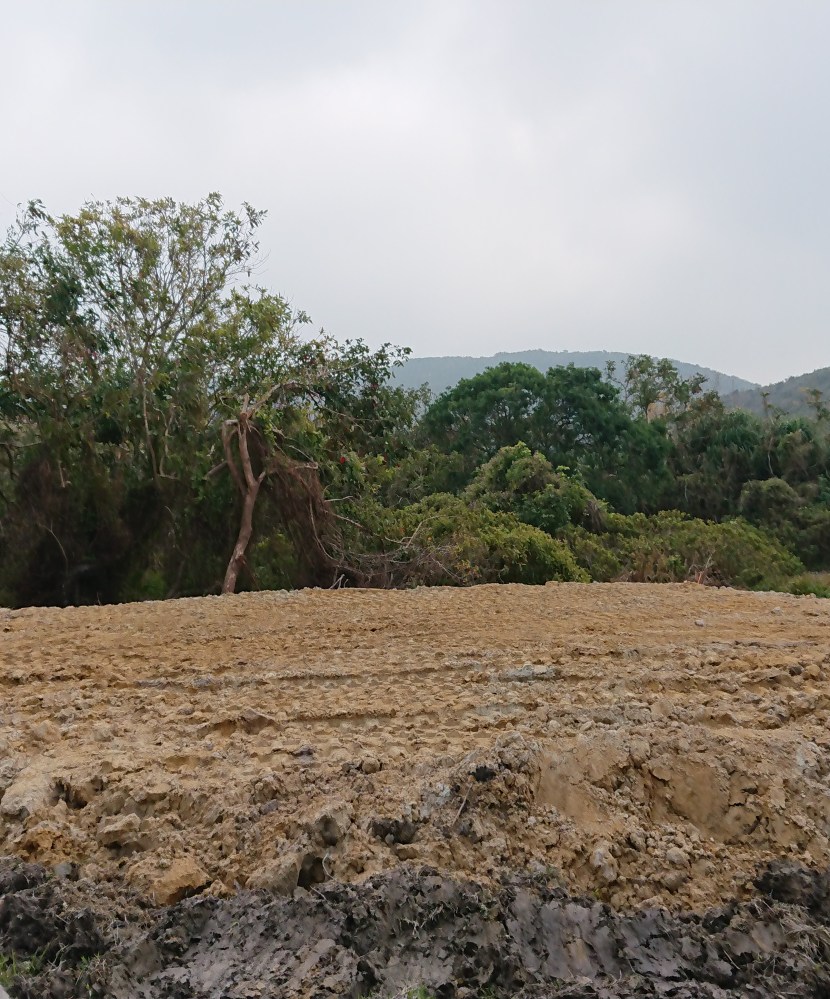
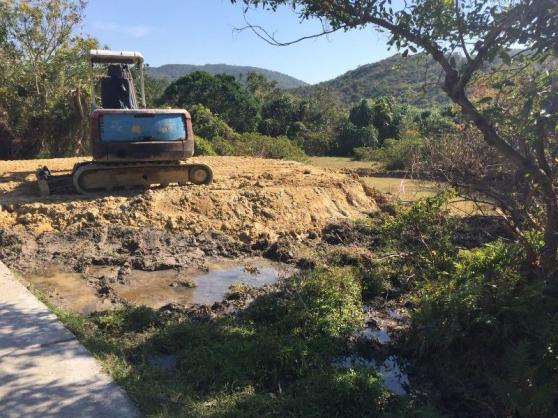
A Shui Hau site appears to have become the latest slice of South Lantau wetland to have been illegally landfilled.
Save Lantau Alliance convenor Eddie Tse discovered the landfilled site, about two-thirds between the village and the shore, a week ago.
The Coastal Protection Area (CPA) site is not approved for any development and has received no ‘acknowledgement’ for landfilling from the EPD.
In reply to inquiries, the Planning Department said that the TPB had not received any planning application for the site.
The Environmental Protection Department (EPD) said that it received two complaints over landfilling there earlier this month, Commercial Radio reported.
Landfill work last week (Credit: Save Lantau Alliance)
EPD officials have reportedly inspected the location and told Commercial Radio that if there is evidence of a breach of the Waste Disposal Ordinance (WDO), “the department will certainly take enforcement action.”
It has used the same language in the most recent Pui O case, which likewise appears to be a blatant breach of the WDO, a law that allows for waste dumping only with EPD approval.
Despite strong evidence, including video footage of dumping taking place prior to EPD ‘acknowledgement,’ the department has taken no action.
Its passivity flies in the face of the government’s own policies and aspirations. The Sustainable Lantau Blueprint has identified north Lantau as a focus of development and South Lantau for conservation.
The plan has allocated 162 ha in South Lantau for CPA land, which it says it is intended to
“conserve, protect and retain the natural coastlines and the sensitive coastal natural environment, with a minimum of built development. It is also intended to safeguard the beaches and their immediate hinterland, and to prevent haphazard ribbon development along the South Lantau Coast. A long strip of land between the coastline and South Lantau Road stretching from Pui O to Shui Hau and the sandy shore of the gazetted bathing beaches at Pui O, Cheung Sha and Tong Fuk are zoned CPA.”
Despite the name, the CPA carries no enforcement mechanism.
In this latest case the government has shown once again it is unwilling to use the enforcement tools that it has to hand.
In a new episode of his travel series 48 Hours, former IT Crowd star Richard Ayoade leads Jon Hamm (Mad Men) on a whistlestop tour of Hong Kong.
Filming over Christmas, the droll pair taste offal skewers, buy corduroy suits and survive a bruising encounter with a masseur before taking the cable car to Ngong Ping.
Or as Ayoade calls it, En-gong Ping.
“That’s a big Buddha,” they agree as the bronze icon comes into view.
In Ngong Ping, they share a moment with a four-legged resident and discuss the lyrics of Kenny Rogers.
“This is the path to enlightenment,” remarks Hamm as they reach Ngong Ping Village.





 Lantau Confidential