
Category: Temples

Luk Tei Tong villagers to protest today against ‘illegal’ columbarium
Luk Tei Tong villagers will hold a protest this afternoon over construction of a private columbarium inside a local temple.
They say the columbarium would breach land use regulations and result in a large number of visitors to the small village, which connects to Mui Wo by a single path.
Luk Tei Tong indigenous village head Tsang Wunwai says residents are unanimously opposed to the columbarium, which has been enabled by the introduction of a private columbarium law last year.
The To Yuen Tung Temple, which was built in the 1960s, has applied for a licence to build a private columbarium.
It is not clear how big the columbarium will be. According to an Oriental Daily report, the temple will have 4,000 slots for urns, while HK01 reports the number as “more than 1000”.
Tsang told HK01 that the columbarium would affect daily village life and called on the new Private Columbaria Licensing Board to reject its application. He said he wouldn’t rule out the possibility of blocking traffic to the village.
He said residents discovered that urns were being hosted on the site about five or six years ago and had complained to several government departments.
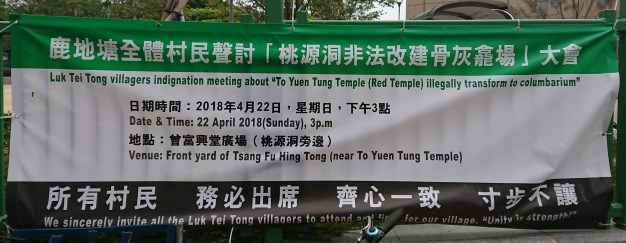
Indignation meeting today
The villagers argue that the project is illegal because the Lands Department has determined is that storing human ashes on the site breaches its land use provisions.
However, the application is now with the PCLB, along with more than 140 others.
The Food and Environmental Hygiene Department says the To Yuen Tung application was still being processed. It must prove to the licensing board that all requirements have been met, including land use, planning, fire safety and environmental impact.
The To Yuen Tung application is one of six such from across Lantau.
The Lands Department found that one site, Nim Yuen village near Tung Chung, was also in breach of land use rules, but the department lost its case before the High Court to have it shut down.
Photo (top): Under construction (Source: HK01)
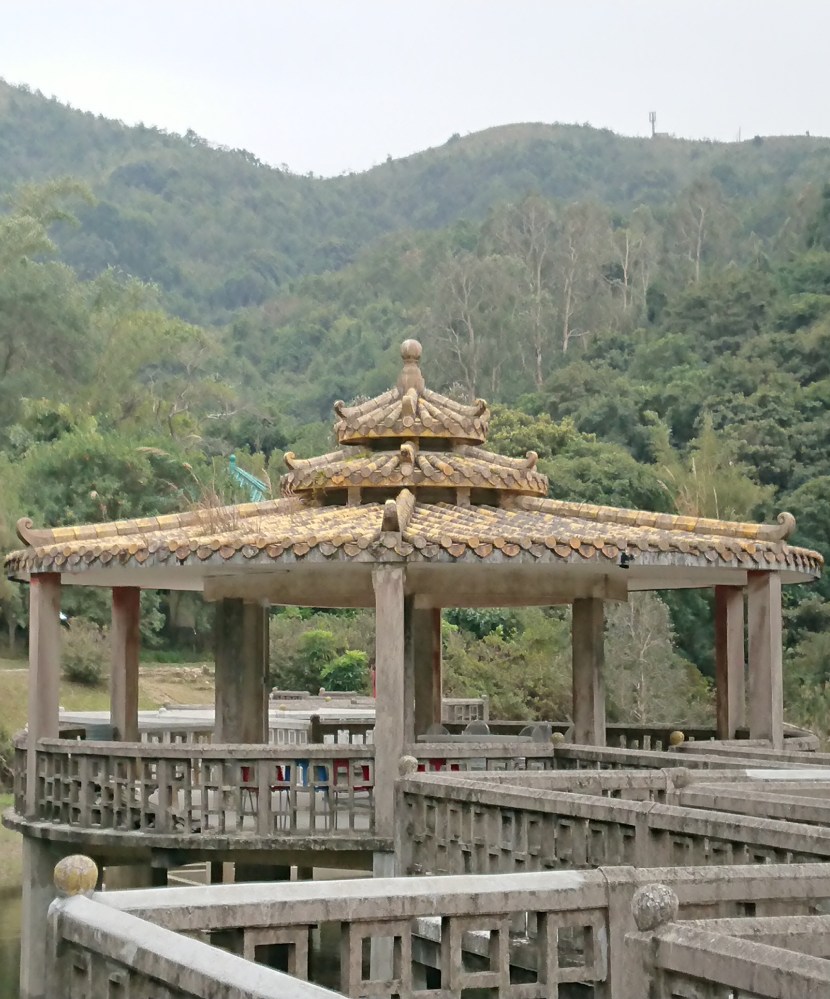
The rebirth of Lung Tsai Ng Yuen, Lantau’s hidden gem
After decades of neglect, one of Lantau’s forgotten gems has been returned to its former quiet glory.
Lung Tsai Ng Yuen – the name means Garden of Enlightenment at Lung Tsai – has been restored as a retreat in the hills of southwest Lantau.
Founded in 1962 by textiles baron Wu Kunsheng as a secluded garden and religious haven, it fell into disrepair after his death.
It is well-remembered locally. Older Lantau residents recall visiting as children, where they played in the gardens and witnessed its exotic wildlife collection.

Upper cottage and garden
In the last five years Wu’s grandchildren have raised and spent a hefty sum on restoring Ng Yuen’s buildings and gardens.
A writer from Economic Times described a visit 18 months ago:
“Once upon a time, Ng Yuen was hailed as a ‘Hidden Paradise’ on Lantau Island. The valley was full of green bamboo plants and the zigzag bridge crossed the lotus ponds. In the glory days of the 1960s, the garden also raised peacock and deer. Recently, the desolate garden retreat has returned to life.”
The refurbished main building, with its green curved roof, now hosts occasional visitors.

Lotus pond and bridge
The top floor offers a view of the revitalised garden. Once badly overgrown, it has been trimmed back to reveal its rich natural treasures. It is now carefully maintained.
Local botanic artist Sally Bunker, who helped restore the garden, says it is home to a number of rare and protected native plants such as rhodoleia and champaka.
The water pine that stands at the edge of the pond is one of only a few hundred in the world.
Founder Wu Kunsheng, born in Shanghai, was a devout Buddhist who used to go to the nearby Mancheung Po Temple to perform merits.
He was inspired by the quiet hills of western Lantau, which have long been a base for religious activity, and decided to build his own retreat.

Zigzag bridge and pavilion
According to EJ Insight:
Construction work started in 1962, and Wu’s garden took four years and HK$2 million [about HK$200 million in today’s money] to complete. He called it Ng Yuen and opened it to the public.
Lung Tsai Ng Yuen follows the classical architectural style of Jiangnan gardens. The two-storey main building lies in the south of the garden and houses various Buddhist articles.
As well as its beauty and serenity, the lovingly restored site is a link to Hong Kong history.
One of many Shanghai exiles to flee to Hong Kong after the communist takeover, Wu co-founded Wyler Textiles in the late 1940s.
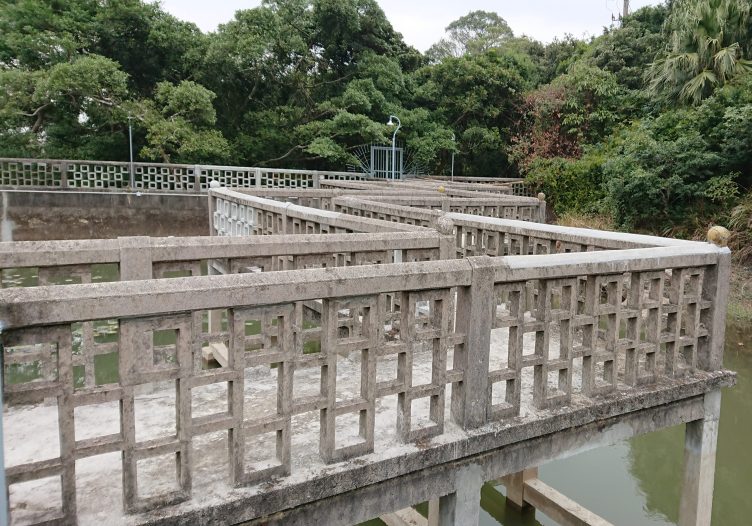
More zigzag
Starting with a single spinning plant at To Kwa Wan, it became one of Hong Kong’s biggest textile firms in the ‘50s and ‘60s when textiles was the city’s largest industry.
One thing that has not changed about Lung Tsai Ng Yuen is its inaccessibility.
There is no road, though it can be be reached on foot by a number of ways (see below).
If you do travel there, remember it remains not only a quiet retreat but also a private property. Please respect the wishes of the occupants not to be disturbed.

Pond pavilion
GETTING TO LUNG TSAI NG YUEN
Up Lantau Trail Section 6 from Tai O (about 45 minutes-one hour);
Via Lantau Trail Section 5 from Keung Shan Road (Sham Wat turnoff) (one and a half to two hours)
Via Keung Shan Path (about 40 minutes)
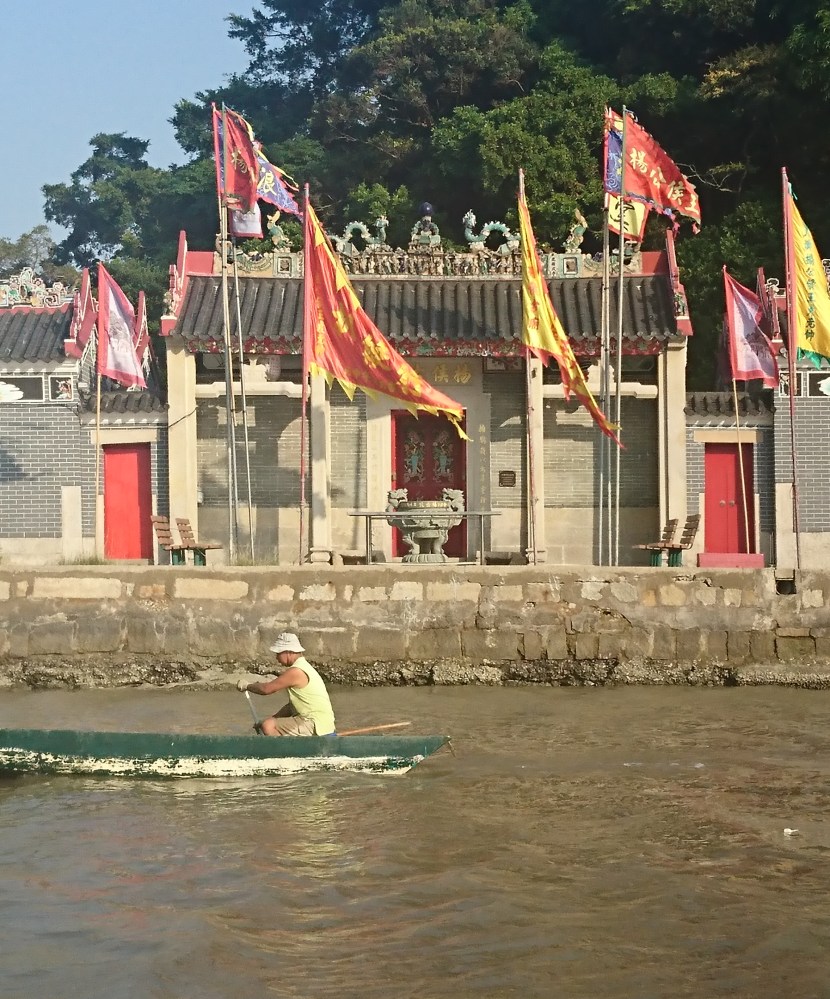
Tai O’s 300-year-old Yeung Hau Temple declared a monument
Yeung Hau Temple in Tai O, one of Lantau’s oldest buildings, has been declared a monument.
The temple, originally built in 1699, is one of a number of Hau Wong temples across Hong Kong and southern China, most of which honour Yeung Leung-jit (楊亮節) a courtier celebrated for his loyalty in staying by the side of the young Song emperor as he fled the advancing Mongol forces in the 1270s.
However, the Chinese Temples Committee notes that the Tai O temple may also have been named after a local villager called Yeung who cured the emperor of an illness.
The temple, which contains a cast-iron bell struck in 1699, was extensively renovated in 1827, 1877 and 1988.
By ‘declaring’ a site, the Antiquities Office is empowered to prevent or limit alterations. The authority website explains:
The temple is one of the oldest temples in Tai O and has long been patronised not only by fishing folk and fisheries merchants in Tai O, but also by merchants from the neighbouring places and the Qing soldiers along the coast. The temple is also popular for its strong association with the Tai O dragon boat water parade, which is a traditional festive event with a history of over 100 years and was inscribed onto the third national list of intangible cultural heritage of China in 2011.
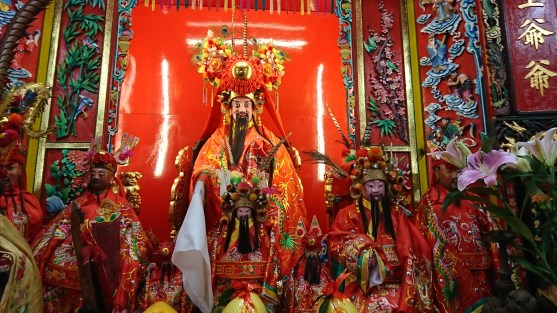
Built on the northern edge of Tai O the temple sits today just a few hundred metres away from the Hong Kong-Macau Bridge.
Hong Kong has 117 declared monuments, including six on Lantau Island (map). The other Lantau sites are: Shek Pik Rock Carving,Tung Chung Fort, Fan Lau Fort, Fan Lau Stone Circle, and Tung Chung Battery.


Anita Mui’s ashes at Po Lin temple
Lantau’s Po Lin Monastery is the final resting place of the late superstar Anita Mui Yim-fung, it has been revealed.

Mui died of cervical cancer in 2003, aged 40, but the fate of her ashes has been unknown to all but a few fans, even though hundreds turn out to commemorate her birthday and the anniversary of her death each year.
A devout Buddhist, Mui’s ashes are in a columbarium at Po Lin under her milk name, Jyu Neuih (珠女), the head of Mui’s fan club told NOW TV. Continue reading
 Lantau Confidential